After-school routines
How to prioritise homework when several tasks are due
Put every task on one list, check the real deadline and purpose, estimate the effort, identify dependencies, and choose the smallest useful first action.
Published

Make one complete task list
Collect assignments from the school platform, planner, messages and loose papers. Write one row for each task with the subject, exact output, deadline and where the instructions live. “Science” is too vague; “label the cell diagram and upload one photo by Thursday” can be planned.
Check whether the deadline means the start of class, the end of the day or an online submission time. Mark any task whose instructions are missing instead of guessing what the teacher wants.
The opening homework photograph is AI-generated with fictional Indonesian people. It does not show a real tutor, learner, school or client plan.
Use four factors to set priority
Start with the deadline, then consider the consequence of delay, the likely effort and whether another task depends on it. A short task due tomorrow may go first. A larger project due later may still need an early step if it requires materials, research or feedback.
Quality matters more than filling every available minute. Evidence guidance on homework emphasises clear purpose, links with classroom learning, barriers to completion and feedback. The plan should protect the learning purpose rather than reward speed alone.
| Factor | Question | Planning response |
|---|---|---|
| Deadline | When is the work actually due? | Put fixed near deadlines where they can be seen |
| Consequence | What happens if it is late or incomplete? | Protect assessed, submitted or group-dependent work |
| Effort | How much focused time is realistic? | Split large tasks into visible steps |
| Dependency | What must happen before the task can continue? | Request instructions or materials early |
Choose a first action, not a whole project
Turn the top task into an action that can begin now: open the rubric, answer questions 1 to 3, find two sources, or draft the first paragraph. A learner who sees a concrete start is less likely to spend the first study block reorganising the list.
Estimate a block and stop point before beginning. At the stop point, record what is complete and write the next action. This creates a useful restart cue if the task needs another session.
Plan around energy and available resources
Place work that requires explanation, new thinking or sustained writing during the learner’s more alert period. Use a lower-energy period for packing materials, uploading finished work or checking a short set.
If a device, textbook, quiet space or adult clarification is missing, record the barrier and choose a task that can move forward. Ask the teacher about unclear instructions early. Silent delay is rarely improved by repeatedly staring at the same incomplete page.
Review the plan before finishing
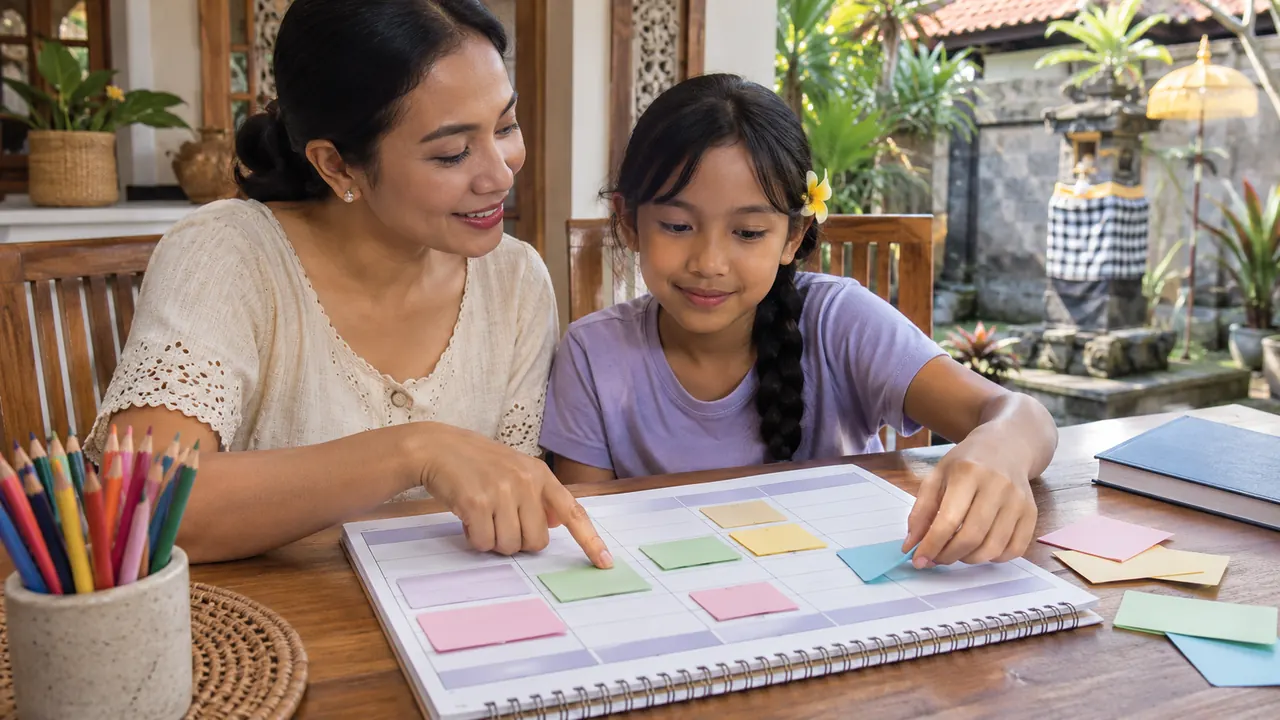
This homework-planning image is AI-generated with fictional people and does not document an actual family routine.
At the end of the block, update the list with completed work, new information and the next deadline. Do not carry every task forward unchanged. Reassess what still matters and remove duplicate reminders.
A weekly review can look for patterns: repeated missing instructions, underestimated writing time or a subject that always starts too late. That evidence can guide a better routine or a focused conversation with the school.
Get help building an after-school routine
If several deadlines repeatedly turn evenings into negotiation, bring the real task list and school expectations to an after-school tutoring discussion. The commercial after-school page owns service enquiries; this guide provides a prioritisation method.
Families in Canggu can also review the Canggu tutoring area page. For broader planning, the revision timetable guide shows how to schedule several exams.
Frequently asked questions
Should the shortest homework task always come first?
No. Consider deadline, consequence, effort and dependencies. A short task can create momentum, but it should not displace more urgent or higher-consequence work.
What should a child do when homework instructions are unclear?
Record the question, check the approved school source and ask the teacher or school contact early. Work on a task that can progress while waiting rather than inventing requirements.
Related
Message us on WhatsApp: +62 858 6969 6869 · info@privatetutoringbali.com · We reply within one working day.