Exam planning skills
How to make a revision timetable for multiple exams
Put fixed exam dates on one page, rank topics by need and importance, then allocate realistic study blocks that include recall, questions, checking and rest.
Published

Start with fixed dates and real available time
List every exam with its date, paper and known content. Add school hours, travel, sleep, family commitments and activities that cannot move. The timetable must fit the learner’s actual week, not an imaginary week with unlimited energy.
Count backwards from each exam and identify the last sensible day for learning new material. Leave later sessions for retrieval, mixed questions and checking. A paper scheduled first may need earlier attention even when another subject feels harder.
Use the downloadable revision planning template to place those exam dates, topic blocks and later reviews on the same weekly grid.
The opening revision photograph is AI-generated with fictional Indonesian people. It does not show a real tutor, student, school or client plan.
Rank topics instead of treating them equally
For each subject, mark topics as secure, partly secure or not yet secure. Add a second marker for exam importance, using the syllabus or specification rather than guesswork. A weak topic that appears often deserves more time than a secure topic that is easy to revise.
Use recent work to support the rating: a topic checklist, marked assessment, teacher feedback or an honestly attempted past-paper section. Do not convert one bad evening into a permanent judgment about the whole subject.
| Priority | Current evidence | Best next block |
|---|---|---|
| High | Weak understanding and important exam content | Brief reteaching, retrieval, then focused questions |
| Medium | Partial understanding or inconsistent accuracy | Retrieval followed by mixed practice and checking |
| Low | Secure in recent work | Short spaced review to prevent forgetting |
| Unknown | No recent evidence | A small diagnostic set before allocating more time |
Build study blocks with a clear outcome
A block should name the subject, topic and action. “Chemistry, empirical formula: complete four calculations and correct errors” is more useful than “revise chemistry”. Keep blocks short enough for focused work and include a brief break before attention falls sharply.
Mix methods across the week. Retrieve from memory, answer questions, mark or check the attempt, and record the exact gap. Rereading can introduce a topic, but it does not by itself show whether the learner can produce an answer without the page open.
Spread subjects without fragmenting every evening
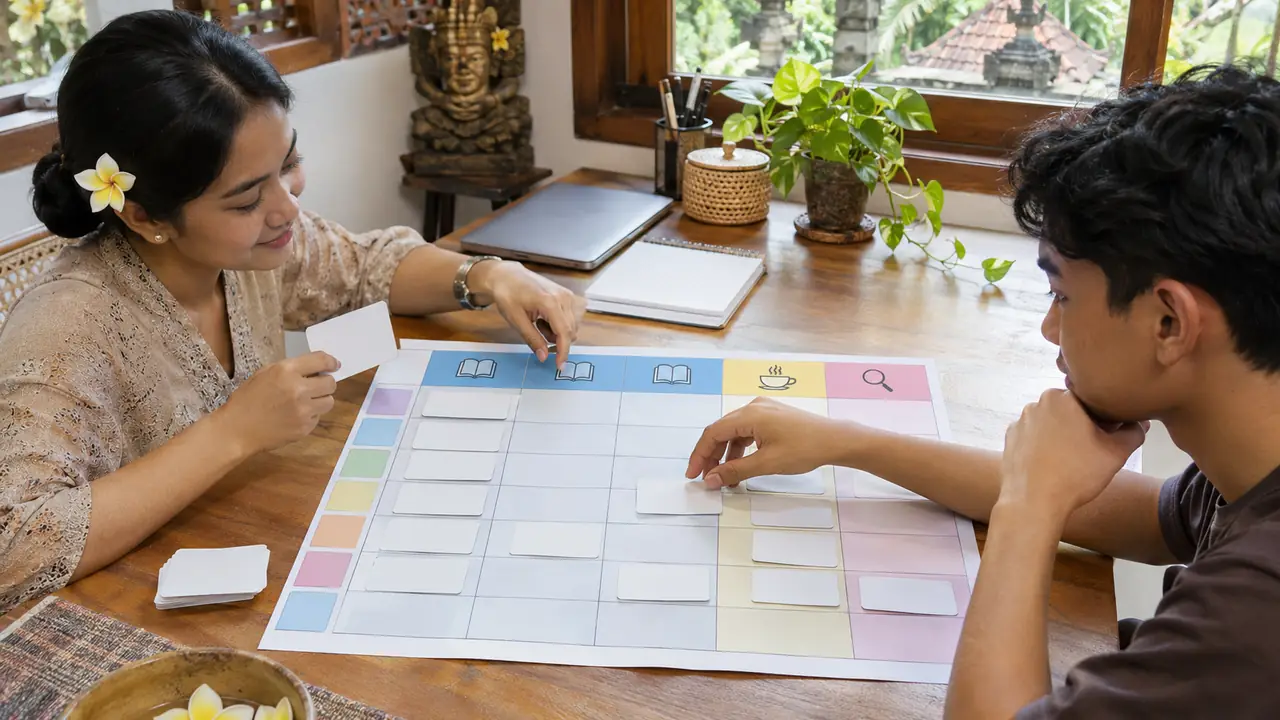
This calendar-planning image is AI-generated with fictional people and does not document an actual revision programme.
Several exams require spacing, but switching subject every ten minutes creates setup cost. Give a block enough time for one complete learning cycle, then move to a different kind of task. A calculation block can be followed by vocabulary retrieval or essay planning.
Place the hardest work at the time when the learner is usually most alert. Protect sleep and at least some unscheduled time. A timetable that fills every free minute often collapses after one delay and can make recovery feel impossible.
Review the timetable once a week
At the end of the week, mark completed blocks and record what changed. Move unfinished high-priority work deliberately; do not copy every missed task into an ever-growing backlog. Update topic ratings using new evidence.
As exams approach, increase work with the correct paper format and time limits. Use the exact paper, syllabus and mark scheme where available. Keep a small error log so the next block targets a cause rather than repeating a whole paper without reflection.
Get help planning exam preparation
If several syllabi, papers and topic gaps make the plan difficult to prioritise, bring the exam calendar and recent evidence to an exam preparation discussion.
Families based on Bali’s east coast can review the Amed tutoring area page. For the next level of detail, use the revision timetable resource.
Frequently asked questions
How many subjects should be revised in one day?
There is no universal number. Choose a manageable set of complete blocks based on available time, attention and exam proximity, while protecting sleep and breaks.
What should happen when a revision block is missed?
Reassess its priority and move it deliberately if it still matters. Do not duplicate every missed task or sacrifice all rest to make the page look complete.
Related
Message us on WhatsApp: +62 858 6969 6869 · info@privatetutoringbali.com · We reply within one working day.