Inclusive teaching
How to make group work accessible for different learners
Design the task so every learner can understand the goal, contribute something that matters and show what they know without one narrow participation route.
Published

Start with the goal, then remove accidental barriers
Group work can fail before the group forms. A dense instruction sheet, rapid verbal directions, an undefined role or a demand to write and speak at the same time may test access skills rather than the intended learning.
Write the goal in one sentence: what should each learner understand or practise by the end? Keep necessary challenge. Adjust the route into the task, the way information is presented and the way learners can contribute.
The opening image is an AI-generated editorial illustration with fictional Indonesian people. It does not depict real students, staff, classrooms or a school partnership.
Offer roles that carry real intellectual value
Do not give the learner who needs support a decorative job while others make every decision. Roles can divide the process without dividing status. Rotate them across tasks so one student is not permanently labelled as the writer, speaker or helper.
| Role | Meaningful contribution | Possible access option |
|---|---|---|
| Evidence finder | Selects information that answers the question | Highlighted text, images or a smaller source set |
| Connector | Explains how two ideas relate | Sentence stems, diagram or symbols |
| Checker | Compares the draft with the success criteria | Short checklist read aloud or shown visually |
| Reporter | Shares the group’s reasoning | Speech, recorded audio, slides, AAC or supported co-presentation |
Build more than one way to join the discussion
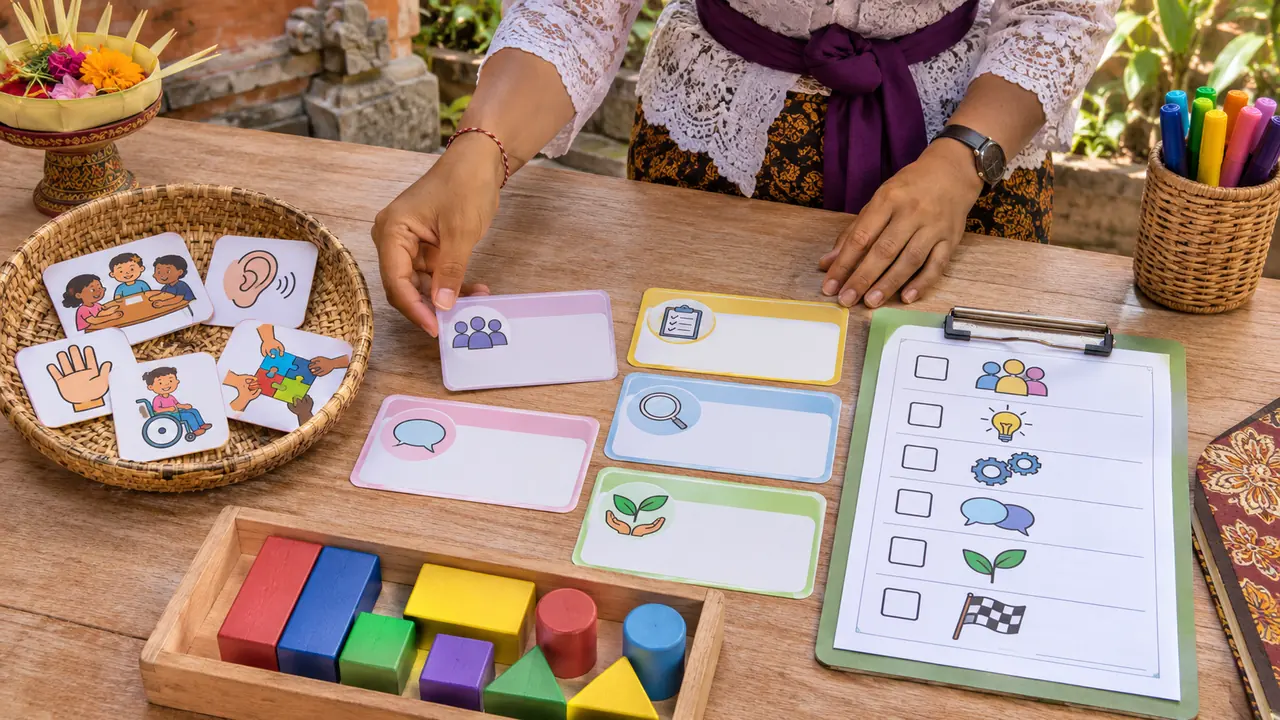
This image is generated for editorial illustration and contains no real school materials or learner records.
Some learners think before speaking; others communicate through writing, pointing, drawing, gesture or AAC. Make these routes available to the whole group. A short individual planning minute before discussion can improve contributions without isolating anyone.
Check physical access to materials and sight lines. Place shared resources where every participant can reach or view them. If a learner uses a device or communication board, leave enough time and space for it to be part of the ordinary turn-taking rhythm.
Assess the learning without rewarding only visibility
The loudest speaker is not necessarily doing the deepest thinking. During the task, ask each learner a precise question linked to the goal. Accept an appropriate response mode and record what the answer shows.
Finish with a brief individual check: one example, one explanation or one choice with a reason. This distinguishes shared group production from each learner’s understanding and tells the teacher what to revisit next.
Review barriers after the lesson
Ask which part of the design helped and where participation stalled. Review the instruction, role, materials, timing, communication options and peer routine before concluding that the learner “does not work in groups”. One change at a time makes the next attempt easier to evaluate.
Families or schools exploring inclusive classroom teaching support can discuss how planning and reasonable adjustments fit the existing school programme. Families around Sanur can use the Sanur tutoring page for local session arrangements.
Frequently asked questions
Should every learner have the same group role?
Roles can differ while each contribution remains academically meaningful. Rotate roles over time and preserve the same learning goal unless an agreed personalised plan changes it.
Does accessible group work lower expectations?
No. It removes barriers that are separate from the intended learning. Keep the intellectual goal clear, then vary representation, participation and response methods where appropriate.
Related
Message us on WhatsApp: +62 858 6969 6869 · info@privatetutoringbali.com · We reply within one working day.