Learning support planning
How to create a one-page learner profile
Summarise the child’s strengths, communication, interests and useful support in one practical page that can travel between home, school and tutoring.
Published

Start with the child, not a list of needs
A one-page learner profile gives the adults around a child a quick, human introduction. It should show what the learner enjoys, what they do well, how they communicate and which conditions help them participate. A diagnosis may be relevant, but it should not become the whole profile.
Invite the child to contribute in a way that works for them. They might speak, draw, point to choices, select photographs or ask a trusted adult to write their words. Separate what the child says from what adults have observed so their voice remains visible.
The opening photograph is an AI-generated editorial illustration with fictional Indonesian people. It does not show a real family, tutor, assessment or support meeting.
Use three sections that adults can act on
Keep the structure short enough to scan before a lesson. Replace broad labels such as “struggles with change” with an observable situation and a useful response, such as “benefits from seeing the order of three tasks before starting”.
Include only information that changes how an adult should communicate, prepare the environment or present the work.
| Profile section | Useful content | Example |
|---|---|---|
| What matters to me | Interests, people, routines and motivators | I like drawing maps and knowing when a task will finish |
| How I communicate | Preferred ways to understand and respond | Give me time, then let me point or write if speaking is difficult |
| What helps me learn | Concrete adjustments and successful strategies | Show one worked example and keep the next step visible |
Write strengths and support with equal precision
Strengths should be specific. “Good at science” is less useful than “notices patterns in experiments and explains them clearly with diagrams”. Specific strengths show how the learner can enter a difficult task.
Describe support without blaming the child. Write “check that the instruction was heard before adding another step” rather than “does not listen”. Record strategies that have actually helped, and identify which person observed them.
Review the page together in fifteen minutes
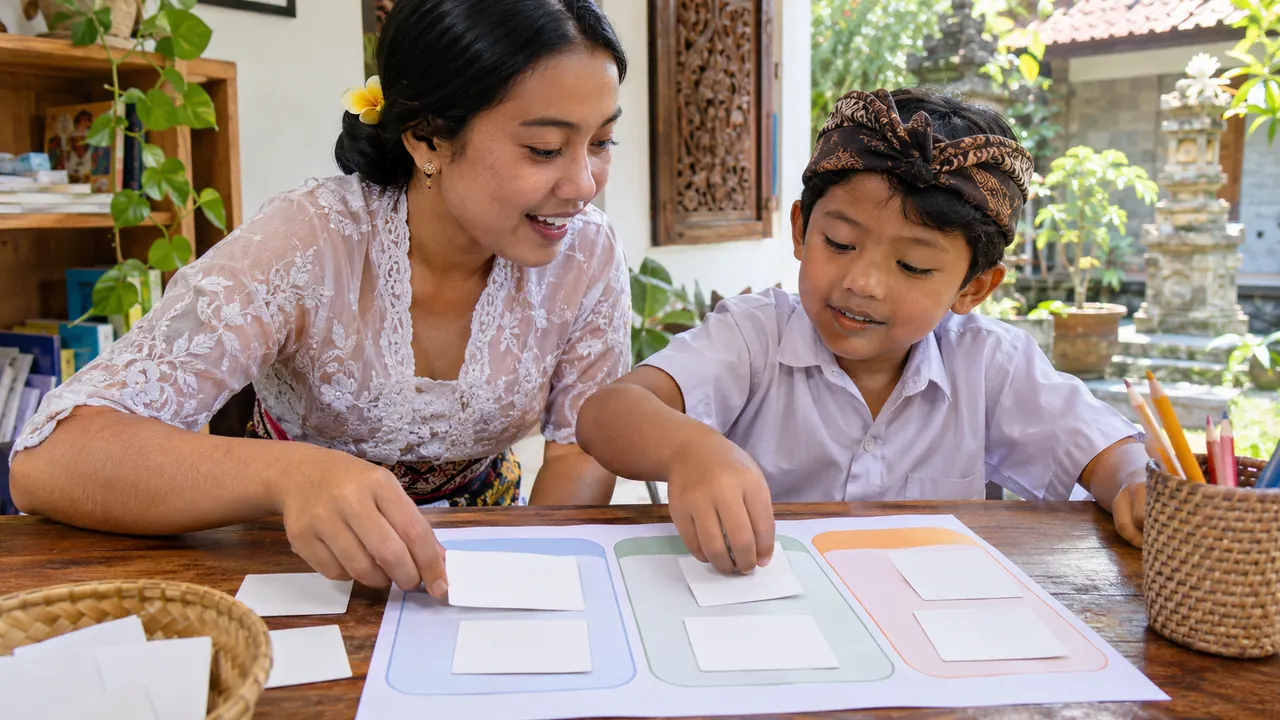
This second image is an AI-generated editorial illustration. It does not contain a real learner profile or identify a child.
Read every line aloud or make it available in the child’s preferred format. Ask: Is this true now? Is it respectful? Would a new adult know what to do? Remove repeated history and keep the next useful action.
Agree who will update the page and when. A review at the start of a new term, after a school move or when a strategy stops helping is more useful than leaving an old profile in circulation.
Use the profile to start a tutoring conversation
Families can bring an existing profile, school plan or their own notes to a learning-support tutoring discussion. The coordinator can use the practical information to understand the environment and tutor qualities the child may need, while diagnosis and therapy remain with qualified professionals.
Families based around Sanur can review arrangements on the Sanur tutoring page. For a document focused on ongoing adult coordination, see the one-to-one support handover checklist.
Frequently asked questions
Does a one-page learner profile replace an assessment?
No. It is a practical summary of the child’s strengths, communication and useful support. It does not diagnose a condition or replace a school, clinical or therapy plan.
How often should the profile be updated?
Review it when circumstances or successful strategies change and at natural transitions such as a new term, school or tutor. Date the page so readers can judge whether it is current.
Related
Message us on WhatsApp: +62 858 6969 6869 · info@privatetutoringbali.com · We reply within one working day.