Biology practical skills
How to draw a biological diagram with clear labels
Look carefully before drawing. Record the visible outlines and proportions with simple lines, then add straight labels that identify only what you can justify.
Published

Observe the specimen before the pencil moves
A biological drawing records evidence. Spend the first minute identifying the overall shape, the largest structures and the way those structures sit beside one another. If the specimen is under a microscope, move the slide and adjust focus so that the chosen view is clear.
Decide what the drawing is meant to show. A whole leaf needs an outline, midrib and visible vein pattern. A group of cells needs the boundaries and structures that can actually be distinguished. Avoid adding a textbook feature that is not visible in the specimen or supplied image.
The opening photograph is an AI-generated illustration with fictional Indonesian people. It is not a real lesson, member of staff, client, classroom or school partnership.
Make the drawing large and keep the proportions
Use enough of the available space to show detail. Begin with the outer boundary, then place the largest internal divisions. Compare relative sizes as you work: is one region about half the width of another, or only a narrow band?
Draw with a sharp pencil and one clear continuous line. Sketchy repeated strokes make a boundary ambiguous. Biological diagrams usually communicate structure more clearly without shading, colour or decorative texture unless the task specifically requests them.
| Check | Useful question |
|---|---|
| Overall shape | Does the outline match the specimen rather than an idealised symbol? |
| Proportion | Are the main regions the correct size relative to one another? |
| Line quality | Is each boundary shown once with a clean, unbroken line? |
| Visible detail | Have I included only structures I can see or justify? |
Add labels without crossing the drawing
Write labels outside the diagram. Use a ruler to draw straight horizontal label lines that touch the feature precisely. Keep the lines parallel where possible and do not let them cross one another. A label line should not end in an arrowhead unless the course convention asks for one.
Use the biological term that matches the visible structure. If you are uncertain, check the course vocabulary after making the observation rather than guessing. A small number of accurate labels is more useful than a crowded list attached to the wrong features.
Give the diagram enough context
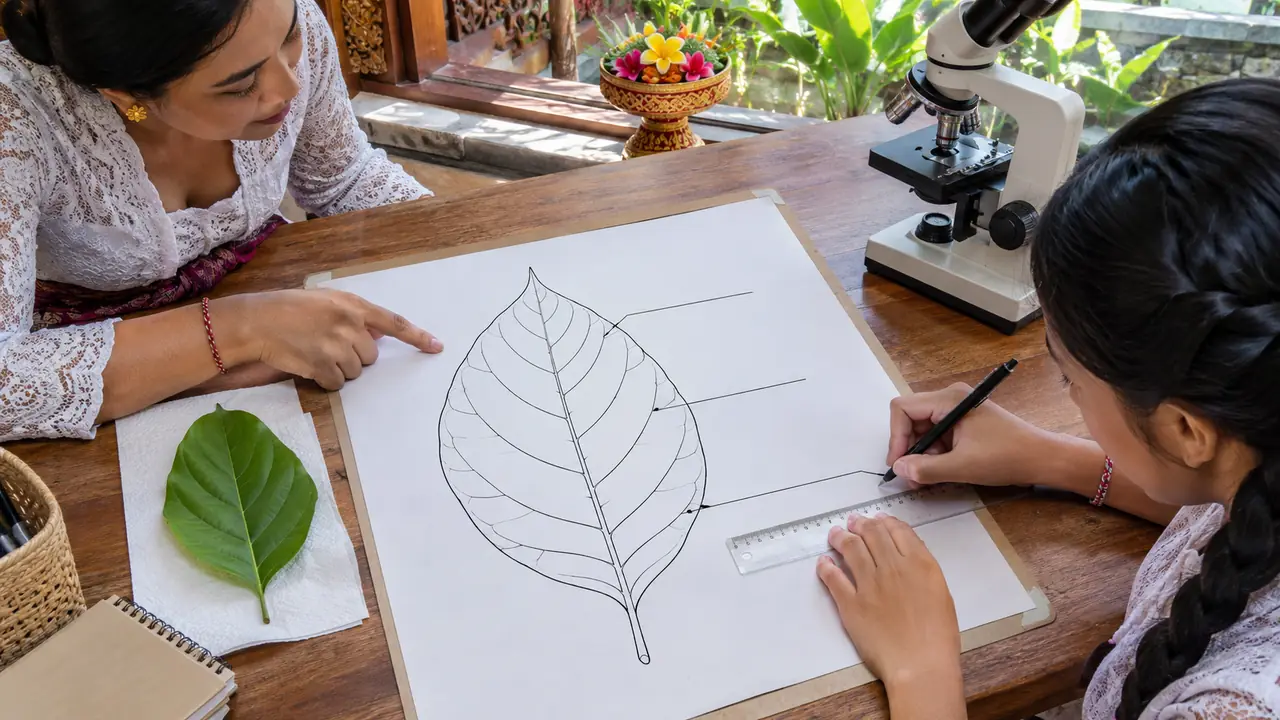
This second AI-generated photograph illustrates line and label checking with fictional people; it does not document an actual tutor, learner or school.
Add a concise title that states what was drawn. When the task requires scale, include the magnification or a scale bar using the method taught by the course. Do not invent a magnification from the apparent size of an image.
Where the actual size or a suitable scale bar is supplied, calculate magnification from the biological image using matching units before adding it to the drawing.
If the drawing comes from a microscope, record the relevant specimen or tissue and the view used. This lets a reader understand what the lines represent and makes later comparison more reliable.
Run a thirty-second accuracy check
Compare the diagram with the specimen one final time. Check outline, relative size, position of important structures, line quality, label spelling and whether every label line lands on the intended feature. Remove construction marks cleanly without erasing a real boundary.
Then cover the labels and identify each structure from the drawing. If the drawing cannot support that explanation, improve the structure rather than making the lettering larger.
Get support with biology practical skills
If a learner knows the content but loses marks through observation, biological drawings or practical write-ups, bring the exact syllabus and a recent task to a biology tutoring discussion. Teacher feedback can help distinguish an observation problem from a labelling or presentation problem.
Families arranging face-to-face lessons around Legian can review the Legian tutoring area page. To use diagrams for memory after they are understood, see how to revise biology diagrams without copying.
Frequently asked questions
Should a biological drawing be shaded?
Usually a clear line drawing is preferred. Follow the instructions and conventions for the specific syllabus or practical task if they require another method.
How many labels should a biological diagram include?
Include the structures the task asks for and that the specimen supports. Accurate, well-positioned labels are more valuable than a crowded list of uncertain features.
Related
Message us on WhatsApp: +62 858 6969 6869 · info@privatetutoringbali.com · We reply within one working day.