Biology measurement skills
How to calculate magnification of a biological image
Measure the image, identify the actual size and put both quantities in the same unit. Divide image size by actual size, then check the scale of the answer.
Published

Identify the two sizes before using the formula
Magnification compares the size of an image with the actual size of the specimen or structure. The relationship is magnification = image size ÷ actual size. Because the units cancel, magnification has no unit and is commonly written with a multiplication sign, such as ×200.
Label the values before substituting them. A printed cell might measure 60 mm while its actual width is 0.3 mm. The magnification is 60 ÷ 0.3 = ×200. The larger number is not automatically the image size, so use the wording and diagram.
The biology scene above is an AI-generated illustration with fictional Indonesian people. It is not evidence of a real tutor, student, lesson, laboratory or school partnership.
Convert units before dividing
Image size and actual size must use the same unit. There are 1,000 micrometres in one millimetre. Convert either value so both are millimetres or both are micrometres, write the conversion explicitly and only then divide.
For example, an image measuring 50 mm of a structure that is actually 250 µm wide needs a conversion. Since 250 µm = 0.25 mm, the magnification is 50 ÷ 0.25 = ×200.
| Given information | Required step | Useful check |
|---|---|---|
| Image size and actual size | Make units equal, then divide | Magnified image should usually give a value above ×1 |
| Image size and magnification | Actual size = image size ÷ magnification | Actual size should be smaller than an enlarged image |
| Actual size and magnification | Image size = actual size × magnification | Keep the output unit stated |
| Scale bar | Measure the bar and use its stated value as a ratio | Do not assume page size equals actual size |
Rearrange the relationship carefully
If the question asks for actual size, divide the image size by magnification. If it asks for image size, multiply actual size by magnification. Writing the full relationship before rearranging is safer than relying on a memorised triangle alone.
Substitute the answer back into the original relationship. If image size ÷ calculated actual size returns the stated magnification, the rearrangement is internally consistent. Then round only as the question or data precision requires.
Treat a scale bar as a ratio
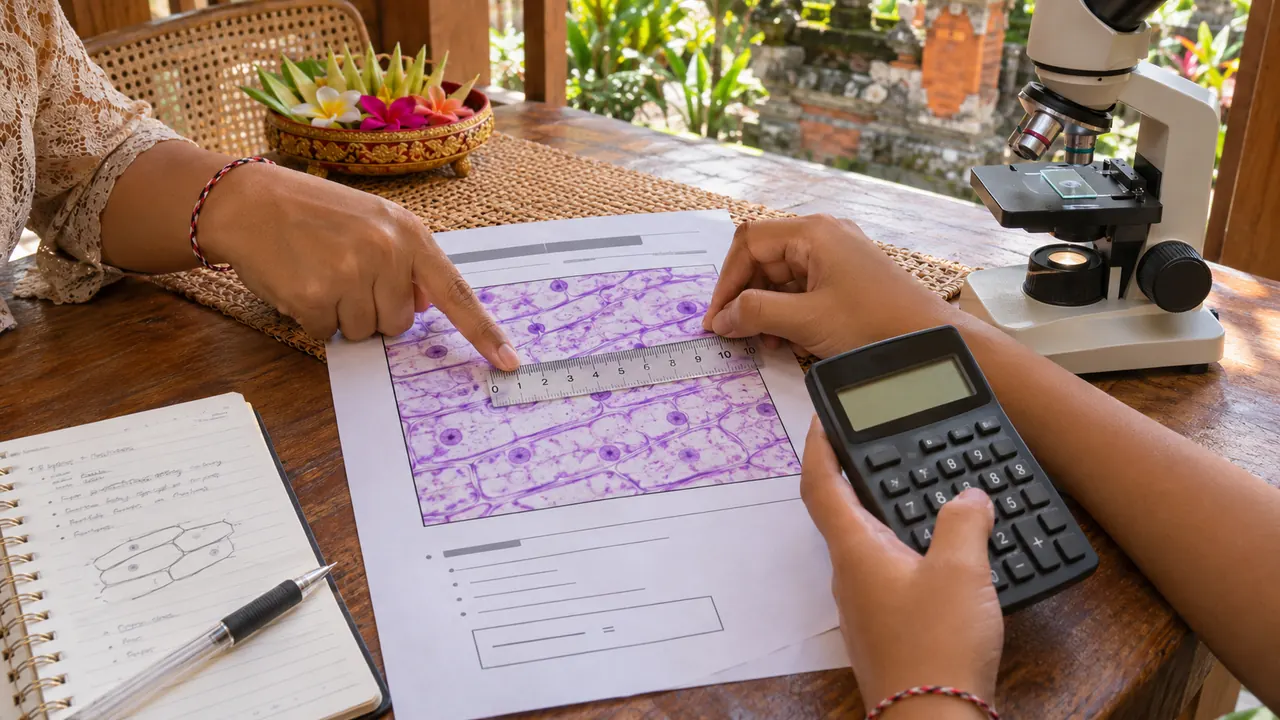
This AI-generated image illustrates magnification work with fictional people; it is not an actual tutoring session.
When an image has a scale bar, measure the bar on the same displayed or printed image and compare that measurement with the actual distance stated beside it. If resizing changes both the specimen image and bar together, the ratio remains useful.
Do not use a ruler measurement from one screen size with a scale bar measured on another copy. Measure both on the same version, and keep the ruler aligned with the dimension requested.
Check whether the magnitude makes sense
A magnified image of a microscopic structure usually produces a magnification greater than one. A result such as ×0.005 often signals reversed division or unmatched units. Recheck the numerator, denominator and conversion before changing the answer.
Also distinguish magnification from resolution. Magnification makes an image appear larger. Resolution determines whether close points can be distinguished. A very large image does not necessarily reveal additional detail.
Strengthen biological calculation skills
If a learner understands the biology but loses accuracy through unit conversion, scale bars or formula rearrangement, bring the current syllabus and a recent question to a biology tutoring discussion.
Families in north Bali can review the Lovina tutoring area page. For recording observations after measurement, see how to draw a biological diagram with clear labels.
Frequently asked questions
Does magnification have a unit?
No. When image size and actual size use the same unit, those units cancel. State the result as a factor such as ×200.
What is the most common magnification error?
Using different units for image size and actual size, or dividing in the wrong order. Label both quantities and convert units before calculating.
Related
Message us on WhatsApp: +62 858 6969 6869 · info@privatetutoringbali.com · We reply within one working day.