Accessible homework communication
How to make homework deaf-friendly
Reduce background noise, keep faces visible, write down the task and check meaning without asking the child to rely on listening alone.
Published

Ask the child how they prefer to communicate
Deaf children do not all communicate in the same way. A child may use spoken language, sign language, lip-reading, hearing technology, written information or a combination. Ask the child and family what works, then use that method consistently.
Do not assume that louder or slower speech is clearer. The National Deaf Children’s Society advises speaking naturally, facing the child and repeating or rephrasing when something was missed.
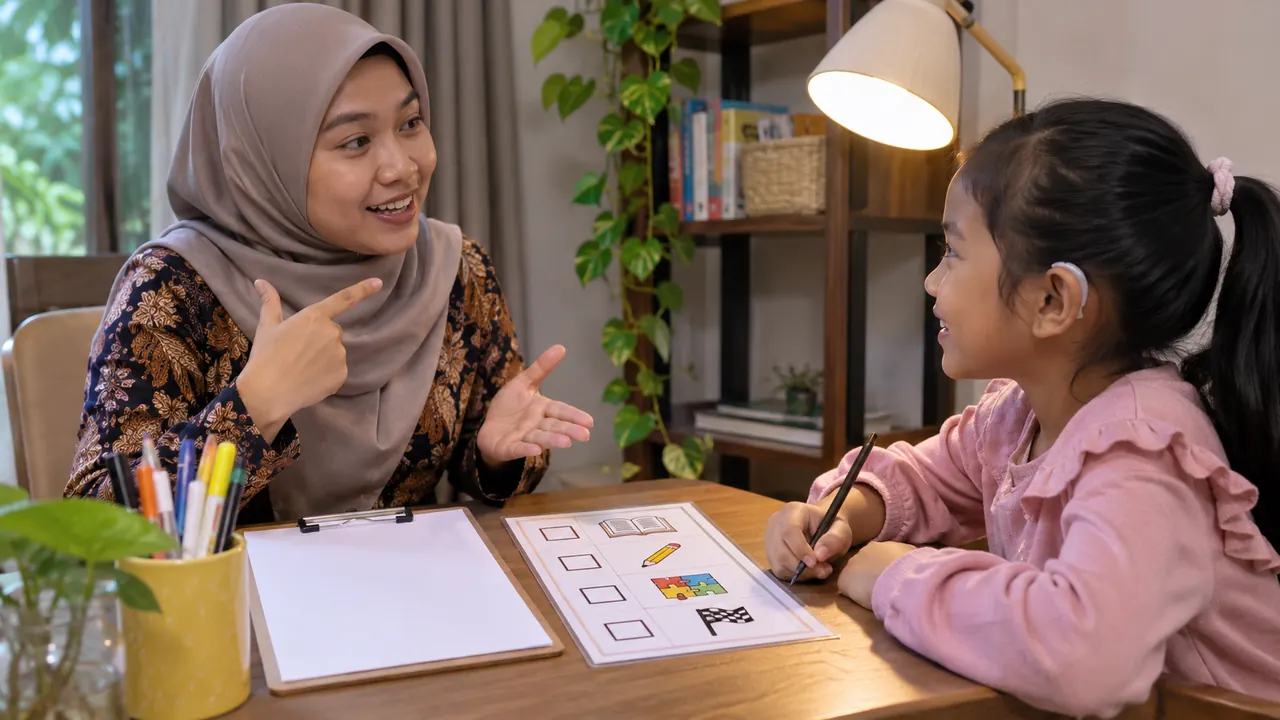
The opening photograph is an AI-generated editorial illustration with fictional Indonesian people. It does not portray a real deaf learner, tutor, hearing device or tutoring relationship.
Set up the room before explaining the task
Turn off television, music and noisy appliances. Sit close enough for comfortable communication and arrange the light so the speaker’s face is visible rather than silhouetted by a bright window.
Get the child’s attention before speaking. Avoid talking while walking around, covering your mouth or looking down at the worksheet. In a group, use one speaker at a time and signal when the speaker changes.
| Barrier | Practical change | Why it helps |
|---|---|---|
| Background noise | Use the quietest available room and switch off competing sound | Makes the main voice easier to access |
| Hidden face | Face the child with even light and an unobstructed mouth | Supports visual information and lip-reading |
| Spoken-only task | Write the instruction, deadline and first step | Allows the child to check details without guessing |
Separate explaining from writing or looking down
A learner cannot watch a speaker’s face and copy from a page at the same time. Explain one short section, pause, then let the child read or write. Put important vocabulary, symbols and deadlines on paper or screen before the work begins.
Check understanding with a practical action such as “show me which question comes first” rather than repeatedly asking “did you hear me?”. Rephrase when needed instead of simply repeating the same sentence louder.
Use a visible homework checklist
This second image is an AI-generated editorial illustration. It does not show a real access plan, lesson or client.
Write the task, materials, first action, finish point and deadline in a short checklist. Visual support should clarify the same learning goal rather than add a second, more complicated task.
Build in pauses because sustained listening and watching can be tiring. Ask the child what signs tell them a break is needed and agree how they can request one.
Align with school and audiology advice
Use hearing technology and communication systems exactly as the child and relevant professionals advise. A tutor should not adjust devices, recommend clinical changes or promise hearing improvement.
If homework instructions are repeatedly unclear, ask the school to provide them at a quiet point and in writing. Keep a brief record of access barriers so the family can discuss patterns with the teacher of the deaf, school or audiology team.
Discuss accessible educational support
Families can explain the child’s communication preferences and existing school arrangements through the hearing-impairment support page. Tutoring can adapt academic communication but does not replace audiology or speech and language therapy.
Families in the Nusa Dua area can review session coverage on the Nusa Dua tutoring page. The one-page learner profile guide can help keep communication preferences consistent between adults.
Frequently asked questions
Should I speak more loudly to a deaf child?
Not unless the child asks you to. Clear, natural speech with a visible face is usually more useful than shouting or exaggerating mouth movements.
Can tutoring replace a teacher of the deaf or audiologist?
No. Tutoring can make curriculum work more accessible and follow established communication arrangements. Specialist hearing, device and clinical advice stays with qualified professionals.
Related
Message us on WhatsApp: +62 858 6969 6869 · info@privatetutoringbali.com · We reply within one working day.