Planning and study skills
How to break a long assignment into milestones
A useful milestone produces something that can be checked. Work backwards from the final submission, define small outputs and leave time to revise.

Start with the submission, not the first study session
Copy the exact due date, required format and success criteria onto one planning page. Then describe what must exist at the end: for example, a 1,200-word report with cited sources and labelled diagrams. This final output is more useful than a vague instruction such as “work on geography”.
Read the brief once for deliverables and a second time for constraints. Circle words that change the work, such as compare, evaluate, practical, bibliography or presentation. If part of the brief is unclear, record the question for the teacher instead of building a plan around a guess.
The opening image is an AI-generated editorial illustration. Its blank materials do not reproduce a real assignment, learner, tutor or school.
Define milestones as checkable outputs
A milestone should leave evidence. “Research” is an activity; “four usable sources recorded with author, date and link” is an output. “Write introduction” is better than “do essay”, but “draft an introduction that states the question and line of argument” is easier to check.
Keep each milestone large enough to matter and small enough to finish in one or two planned sessions. If a learner cannot tell when a milestone is complete, split it again or add a short completion test.
| Vague plan | Checkable milestone | Completion evidence |
|---|---|---|
| Start project | Annotate the brief and list every required output | One requirements checklist |
| Do research | Select and record four relevant sources | Four complete source-log entries |
| Write draft | Draft one section using the planned evidence | A section with a clear claim and citations |
| Finish | Revise against the criteria and export the final format | Checked file ready to submit |
Work backwards and protect the review stage
Place the submission time on the calendar first. Put final checks before it, then revision, a complete draft, section drafts, evidence collection and brief analysis. Working backwards exposes dependencies: a learner cannot write an evidence-based section until the relevant evidence has been selected and recorded.
Do not fill every available day. A missed session, teacher clarification or difficult source can delay the plan. Leave at least one movable block and keep revision separate from drafting. A complete draft on the deadline leaves no practical time to improve it.
Make the next action visible
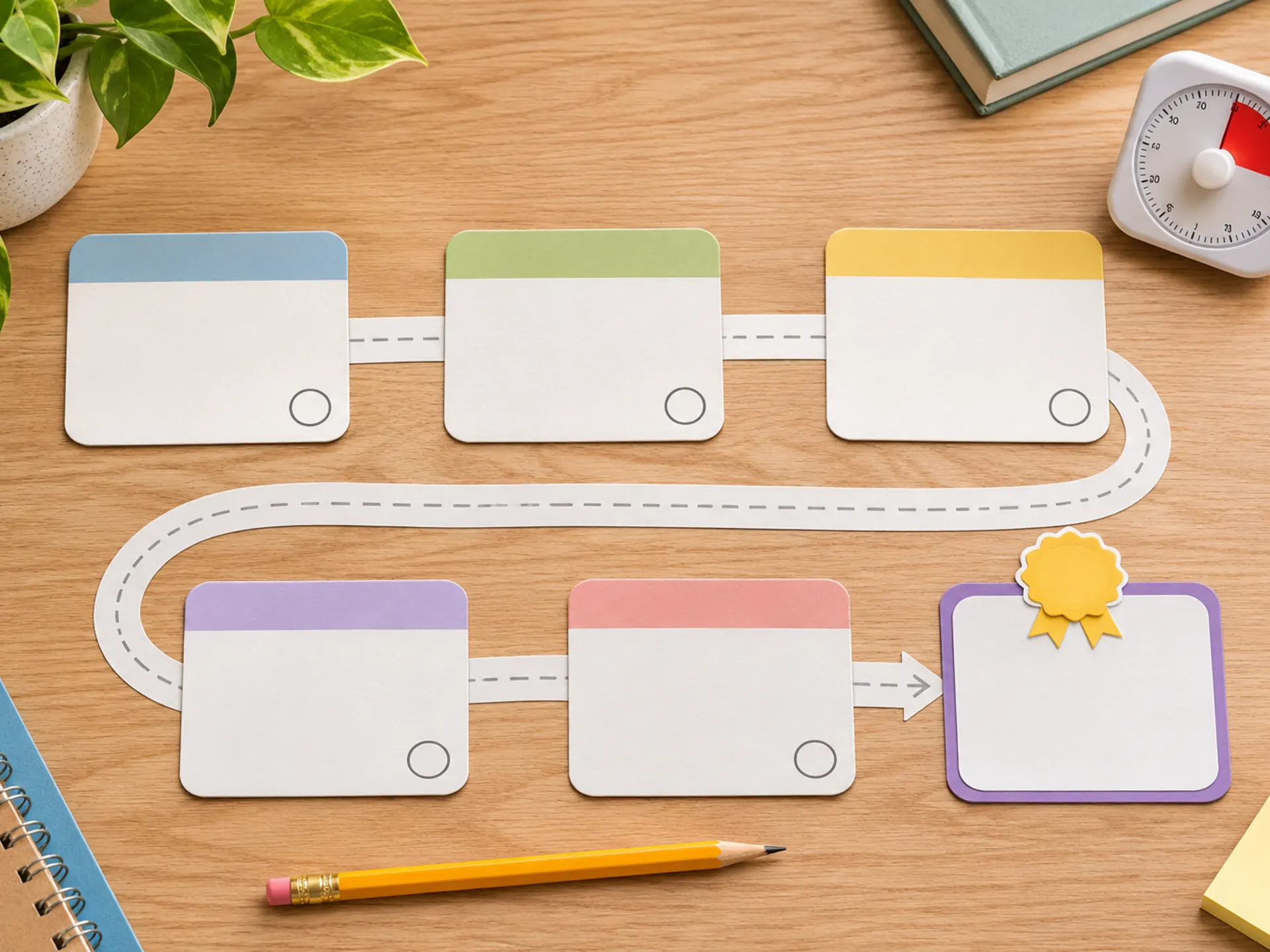
This generated planning scene is illustrative and contains no real student work or personal information.
At the end of each session, write one next action that begins with a verb and names the material: “read source two and record two quotations” is clearer than “continue research”. Put that card at the front of the workspace so the next session begins with a decision already made.
Track actual completion, not time spent. If a stage repeatedly takes longer than planned, reduce the size of later blocks or ask which part needs teaching. Moving unfinished cards silently to the next day hides the problem.
Review progress without taking over the assignment
- Ask the learner to show the current output before discussing what comes next.
- Compare the output with one or two criteria rather than correcting everything at once.
- Let the learner choose between two realistic next steps when both are valid.
- Record teacher questions separately so they do not become family guesses.
- Reduce reminders as the learner begins checking the milestone board independently.
For a first attempt, plan only the next three milestones in detail and keep later stages provisional. The plan should respond to evidence, not become another assignment to obey.
Bring a real brief to a planning session
Families can bring the brief, rubric and current work to a learning-coach discussion. A tutor can help the learner identify dependencies, estimate blocks and practise reviewing progress while leaving the academic decisions with the learner and school.
For in-person support around Denpasar, see the Denpasar tutoring page. The guides to prioritising several homework tasks and starting homework with fewer reminders cover shorter planning problems.
Frequently asked questions
How many milestones should a school assignment have?
Use as many as the task needs, but keep the visible plan manageable. Five to eight checkable stages often reveal the full path without turning every small action into a separate milestone.
What if the learner misses a milestone?
Review the unfinished output, identify the obstacle and revise the remaining plan. Do not simply compress every later stage, especially the time reserved for feedback and revision.
Related
Message us on WhatsApp: +62 858 6969 6869 · info@privatetutoringbali.com · We reply within one working day.