Quantitative chemistry
How to use mole ratios from a balanced equation
The large coefficients in a balanced equation give the reacting mole ratio. Keep formulas unchanged, write one conversion bridge and track units at every step.

Read coefficients as a ratio of amounts
In 2H₂ + O₂ → 2H₂O, the coefficients give a mole ratio of 2:1:2. Two moles of hydrogen react with one mole of oxygen to form two moles of water when the substances react as shown. The coefficients scale: 4:2:4 describes the same proportion.
Coefficients are the large numbers in front of formulas. Subscripts are the small numbers inside a formula. Change coefficients to balance an equation; changing a subscript changes the substance.
The opening molecular model is AI-generated and has been checked against the displayed equation. It is an educational illustration, not a photograph of a real experiment.
Use a three-stage conversion bridge
Write the chemical formula beside every mole value. This prevents a correct number of hydrogen moles from being treated as water moles later in the calculation.
| Stage | Question to ask | Typical operation |
|---|---|---|
| Known quantity to moles | How many moles of the known substance? | mass ÷ molar mass, or concentration × volume in dm³ |
| Known moles to wanted moles | What coefficient ratio connects the substances? | multiply by wanted coefficient ÷ known coefficient |
| Wanted moles to wanted unit | What unit does the question request? | moles × molar mass, or rearrange the relevant mole relation |
Apply one ratio to an original example
Suppose the equation is N₂ + 3H₂ → 2NH₃ and the question starts with 0.60 mol of H₂, with nitrogen available in excess. The ratio from H₂ to NH₃ is 2 mol NH₃ for every 3 mol H₂.
Calculate 0.60 mol H₂ × (2 mol NH₃ ÷ 3 mol H₂) = 0.40 mol NH₃. The H₂ units cancel, leaving the wanted unit. If the question asks for mass, multiply 0.40 mol by the molar mass of NH₃ in a separate final step.
Draw the ratio before using the calculator
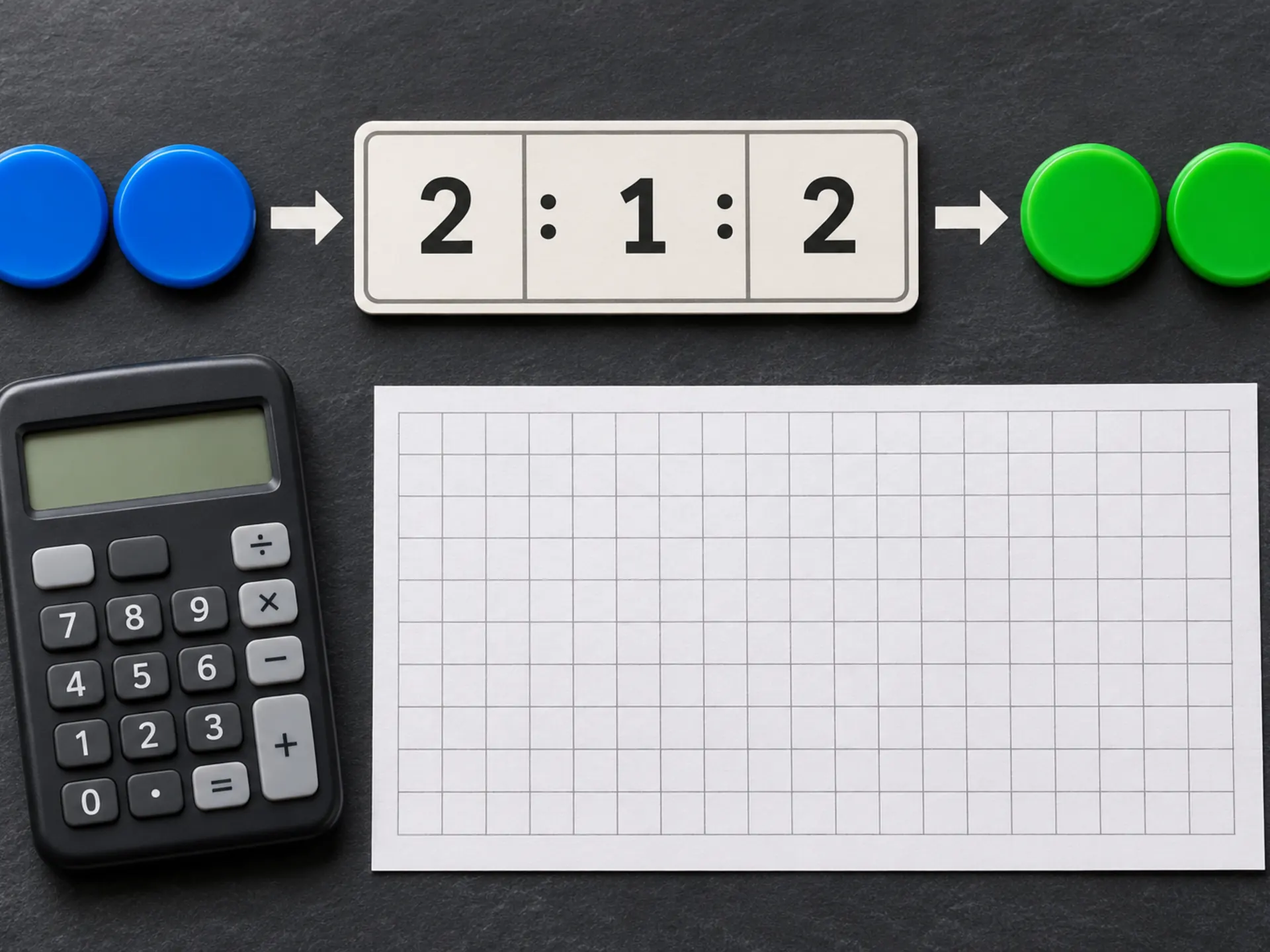
This generated ratio scene is illustrative. The counters represent coefficients, not the size or mass of real particles.
Copy the two relevant coefficients above the substances, then draw the fraction with wanted on top and known underneath. Ask whether the result should be larger or smaller before calculating. In the ammonia example, 0.60 is multiplied by two-thirds, so 0.40 is a sensible direction.
Using one fraction also makes the reasoning inspectable. A string of calculator operations can reach the right answer while hiding a reversed ratio.
Check the four errors that change the answer
- The equation must be balanced before its coefficients can give a reaction ratio.
- The ratio must connect the known substance to the substance asked for.
- Volumes used with mol dm⁻³ must be converted to dm³ when necessary.
- A limiting-reactant question requires comparing available amounts against the ratio; the substance with fewer moles is not automatically limiting.
Keep unrounded values through the working and round once at the end to the precision the question requires. Show units on every line so a mass-to-mass question does not skip the mole stage.
Use a real syllabus question for the next step
Bring the balanced equation and the learner’s full working to a chemistry tutoring discussion. A tutor can locate whether the difficulty begins with balancing, molar mass, unit conversion, the ratio direction or the limiting reactant.
For in-person sessions around Kerobokan, see the Kerobokan tutoring page. Review balancing equations without changing subscripts before ratio work, or practise finding an empirical formula from mass data to strengthen proportional reasoning.
Frequently asked questions
Do coefficients give a mass ratio?
They directly give a mole ratio. To compare masses, convert the mole amounts using the different molar masses of the substances.
Why does the balanced equation come first?
The ratio comes from the coefficients of the balanced equation. An unbalanced equation does not preserve atom counts and cannot supply the correct stoichiometric ratio.
Related
Message us on WhatsApp: +62 858 6969 6869 · info@privatetutoringbali.com · We reply within one working day.