Early spelling skills
How to segment spoken words for spelling
Say the whole word, listen for each sound in sequence, move one counter per sound, and then choose the letter or letters that represent those sounds.
Published

Separate sounds from letters
Segmenting means breaking a spoken word into its individual speech sounds, or phonemes, for spelling. A phoneme is heard. A grapheme is the letter or group of letters chosen to write that sound. One sound may use two letters, as in sh, so the number of sounds and letters is not always the same.
Begin with a short word the child can pronounce clearly. Say the whole word naturally, then repeat it slowly enough to notice the sounds without adding an extra “uh” after consonants. For ship, the sounds are /sh/ /i/ /p/: three phonemes represented by four letters.
The opening early-learning photograph is AI-generated and the Indonesian adult and child are fictional. It does not depict a real teacher, family, classroom or school.
Move one object for each sound
Place three or four counters in a row. Say the word and move one counter into a sound box for every phoneme you hear. The movement makes the sequence visible while the child focuses on listening rather than letter names.
Ask the child to blend the counters back into the whole word. If the result sounds different, say the word again and compare the beginning, middle and end. Keep the exchange playful and brief, especially with younger children.
| Word | Spoken sounds | Sound count | Letters |
|---|---|---|---|
| map | /m/ /a/ /p/ | 3 | 3 |
| ship | /sh/ /i/ /p/ | 3 | 4 |
| chop | /ch/ /o/ /p/ | 3 | 4 |
| fish | /f/ /i/ /sh/ | 3 | 4 |
Choose graphemes in the same order
Return to the first counter and ask which grapheme represents that sound. Write or select it, then move through the remaining counters from left to right. Keeping the sequence stable helps prevent missing middle sounds.
Use grapheme choices the child has already been taught. English has alternative spellings for many sounds, so an unfamiliar word may require adult guidance. The activity practises hearing and ordering sounds; it does not make every conventional spelling predictable.
Read the completed word back
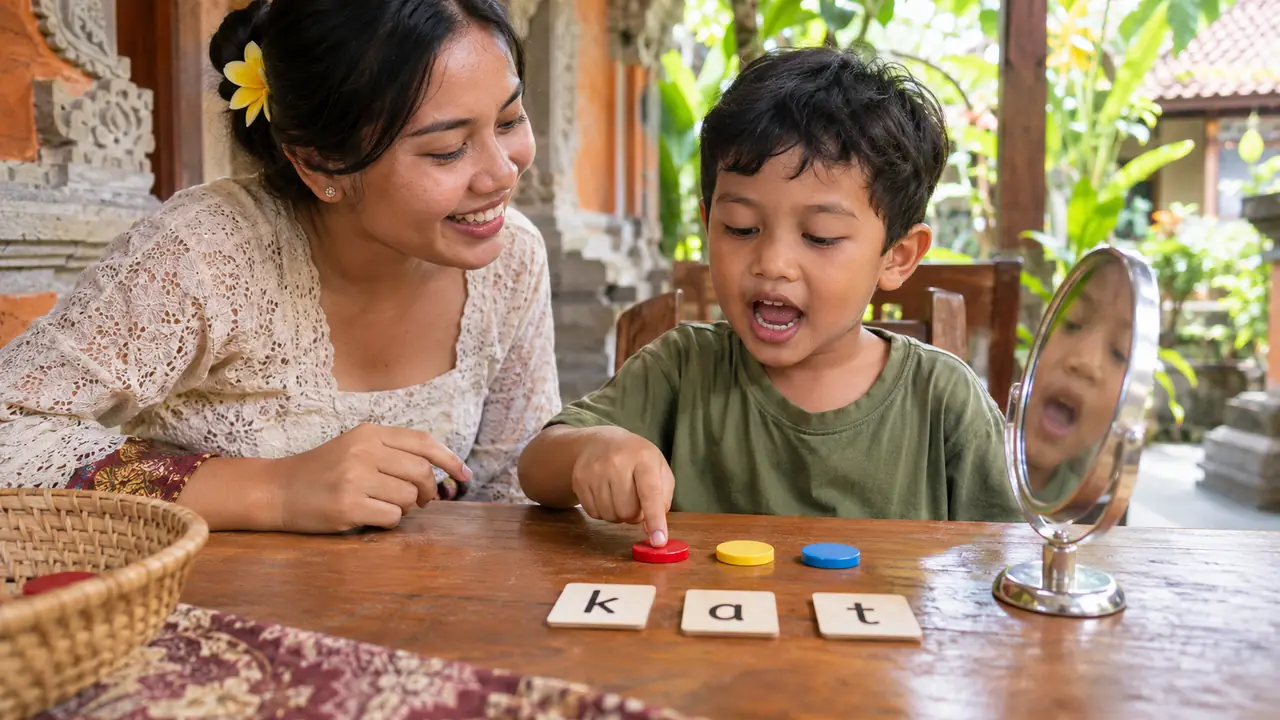
This counter-and-letter-tile scene is AI-generated with fictional people and is not a record of a real literacy session.
After writing, point to the graphemes and blend the word aloud. This checks whether the chosen letters map back to the intended spoken word. If a sound is missing, return to the counters rather than simply supplying the spelling.
Praise the process specifically: “You heard three sounds and kept them in order.” When conventional spelling differs from the most obvious choice, explain the needed grapheme without treating accurate sound analysis as failure.
Know when to make the task easier
Use continuous sounds such as /m/, /s/ and /f/ first because they can be stretched without changing them. Avoid long words, consonant clusters and several unfamiliar graphemes in the same first activity. Five focused minutes can be enough.
If the child cannot yet hear the first sound, play oral games with names, objects and rhymes before asking for written letters. Hearing the sound sequence is the foundation; handwriting adds a separate demand.
Get help with early literacy
If a child enjoys stories but finds it hard to hear, blend or segment speech sounds, discuss the age, language background and school approach through the early years tutoring page.
Families considering sessions around Tabanan can review the Tabanan tutoring area page. For the related reading process, see what to do when letter sounds do not blend into a word.
Frequently asked questions
Is segmenting the same as blending?
No. Segmenting breaks a spoken word into sounds for spelling. Blending combines a sequence of sounds to recognise or read the whole word.
Why can a word have more letters than sounds?
Some graphemes contain two or more letters but represent one phoneme. In ship, sh is two letters representing one sound.
Related
Message us on WhatsApp: +62 858 6969 6869 · info@privatetutoringbali.com · We reply within one working day.