Chess learning skills
How to read and write algebraic chess notation
Name the destination square, add the piece letter when needed, record special details, and replay the moves to confirm that the score matches the game.
Published

Read the board as a coordinate grid
Every square has a name made from a letter and a number. From White’s side, the files run a to h from left to right and the ranks run 1 to 8 from near to far. The bottom-right corner is h1 for White and a8 for Black.
Before writing moves, practise locating a few squares without moving any pieces. Point to e4, c6 and h7, then reverse the task by pointing at a square and naming it. This separates coordinate reading from the harder job of understanding a move.
The opening chess photograph is AI-generated with fictional Indonesian people. It does not show a real tutor, learner, school or client session.
Use a piece letter and the destination square
A move by a piece starts with its capital letter: K for king, Q for queen, R for rook, B for bishop and N for knight. The letter is followed by the destination square. Nf3 means a knight moves to f3, while Be2 means a bishop moves to e2.
Pawns do not use a piece letter. e4 means the pawn on the e-file moves to e4. This small difference is the source of many beginner errors, so it is useful to sort a mixed list into pawn moves and piece moves before recording a whole game.
| Notation | What it records | Check on the board |
|---|---|---|
| e4 | A pawn moves to e4 | No piece letter is written for a pawn |
| Nf3 | A knight moves to f3 | N is used because K belongs to the king |
| Bxe5 | A bishop captures on e5 | The destination square contains the captured piece |
| O-O | Kingside castling | The king and rook both move under the castling rule |
Add captures, check and special moves
Use x before the destination square for a capture. A bishop capture on e5 is Bxe5. For a pawn capture, write the pawn’s starting file, then x and the destination: exd5 means the e-pawn captures on d5.
Add + when the move gives check and # when it gives checkmate. Kingside castling is O-O and queenside castling is O-O-O. A promotion adds the new piece, such as e8=Q. These marks describe the position after the move, so check the board before adding them.
Resolve ambiguity only when it appears
Sometimes two identical pieces can legally move to the same square. Then include the starting file or rank needed to identify the mover. If knights on b1 and f1 can both reach d2, Nbd2 identifies the knight from the b-file.
Do not add the starting square to every move. Algebraic notation stays concise by including extra information only when the legal position requires it. If you are unsure, test which same-type pieces can actually reach the destination.
Replay a short score to find mistakes
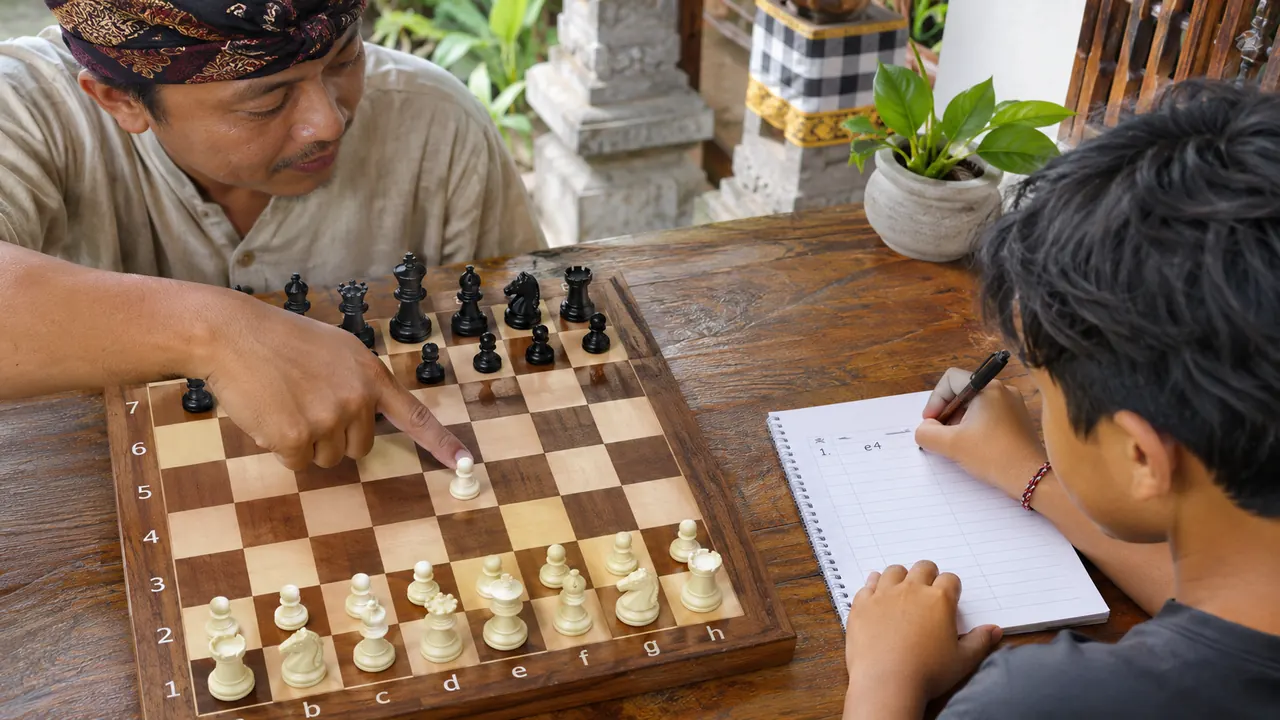
This chessboard image is AI-generated with fictional people and does not document an actual lesson.
After five or ten moves, return the pieces to the starting position and replay the score. Stop where the written move becomes illegal or where the board no longer matches your memory. The error is usually one square name, a missed capture or a move written for the wrong piece.
For practice, record both sides of one slow game. Accuracy matters more than speed at first. Once the notation can recreate the position, the score becomes useful evidence for reviewing missed threats and stronger alternatives.
Get help building chess habits
If a learner can play but struggles to record or review games, bring a recent score or one short game to a chess tutoring discussion. The commercial chess page owns lesson enquiries; this guide teaches the notation process.
Families near Kerobokan can also review the Kerobokan tutoring area page. A useful next step is to replay one annotated game and explain why each check, capture and castle mark appears.
Frequently asked questions
Why is a knight written as N in chess notation?
K is reserved for the king, so standard algebraic notation uses N for a knight.
Do I write the square a piece moved from?
Usually no. Write the piece and destination. Add a starting file or rank only when two identical pieces could legally move to the same square.
Related
Message us on WhatsApp: +62 858 6969 6869 · info@privatetutoringbali.com · We reply within one working day.