Biology practical planning
How to plan a fair enzyme investigation
Change one factor, define a repeatable measure of enzyme activity, keep other conditions controlled and plan a results table before practical work begins.

Begin with the biological relationship
An enzyme investigation should test a biological idea, not simply follow equipment instructions. A clear starting question is: how does one chosen factor affect the measured rate of an enzyme-controlled reaction? The factor might be temperature, pH or substrate concentration, depending on the syllabus and the school’s approved method.
Cambridge IGCSE Biology includes investigating how temperature and pH affect enzyme activity. The plan therefore needs to connect the chosen independent variable to a meaningful rate measurement and an explanation using enzyme action. It should not change several conditions and then guess which one produced the result.
The opening image is an AI-generated editorial illustration of fictional laboratory materials. It is not a real practical, classroom, tutor or school partnership. Students must use their school’s approved method, risk assessment and supervision.
Define each variable in practical terms
Name the independent variable and state the values that will be tested. “Temperature” is incomplete; “water-bath temperatures of 20, 30, 40, 50 and 60 degrees Celsius” is testable. Then define the dependent variable as an observation that produces comparable data.
For a lipase practical, the dependent measure might be the time for an indicator colour to disappear. Rate can then be represented as one divided by time. For an amylase practical, a student might sample at fixed intervals until starch is no longer detected. The endpoint must be applied in the same way for every trial.
| Variable role | Enzyme example | Planning detail |
|---|---|---|
| Independent | Temperature of the reaction mixture | Choose a useful range and confirm the mixture reaches each temperature |
| Dependent | Time to a defined colour endpoint | Use the same endpoint rule and timing start |
| Controlled | Enzyme and substrate volumes | Measure with the same suitable apparatus |
| Controlled | pH when temperature changes | Use the same buffer or approved solution throughout |
Control the conditions that could change enzyme activity
List likely competing explanations. Enzyme concentration, substrate concentration, pH, total volume, mixing, sample interval and the delay before timing can all affect results. Decide how each will be held constant or monitored.
Temperature needs special care. A water bath set to a value does not prove that every solution has reached that temperature. The plan should allow solutions to equilibrate as directed before the reaction starts. It should also use the same order of mixing for each trial.
Practical Biology warns that enzyme preparations can change with storage and that results collected on different days may not be comparable. If trials must be split, record that limitation rather than silently treating the batches as identical.
Plan repeats and the results table before collecting data
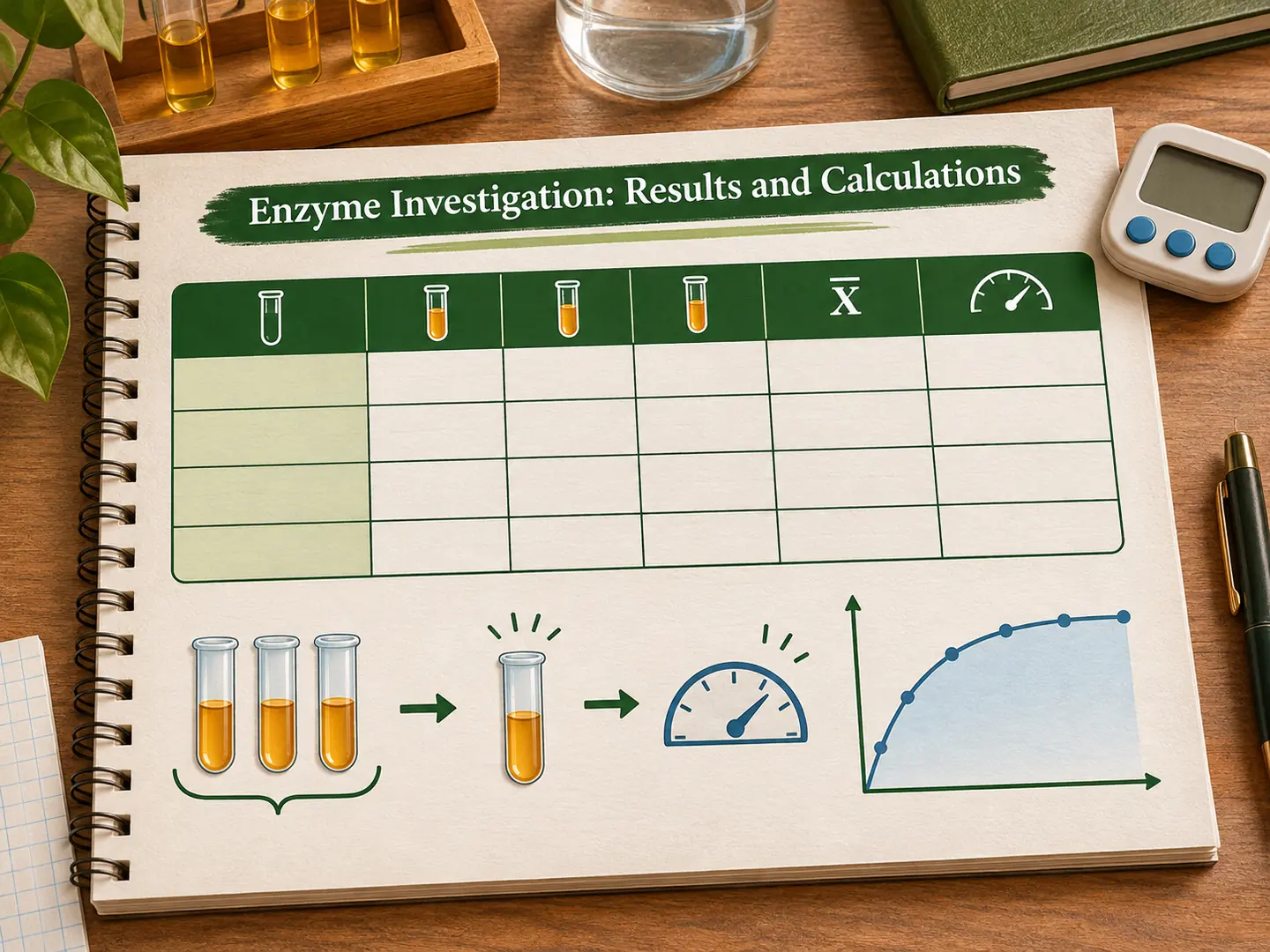
This contextual image is AI-generated and uses invented values. It does not provide a school method, safety instruction or expected result.
Prepare columns for the independent variable with units, each repeat, the mean and any derived rate. Repeating measurements helps reveal random variation and an anomalous value. Do not remove an inconvenient result automatically. Check for a documented reason, repeat the trial if the approved method allows, and explain how the value was handled.
Choose the number and spacing of values before seeing the pattern. If a second investigation is permitted, it can focus more closely around an apparent optimum, but the original range and results should remain visible.
Separate safety from the scientific control list
A control variable improves the comparison. A safety measure reduces risk. Both belong in the plan, but they serve different purposes. Hot water baths, glassware, indicators and biological materials require the school’s current risk assessment and teacher instructions.
Do not improvise chemical concentrations, biological samples or heating methods at home. This article explains planning logic only. The teacher or laboratory technician decides which procedure and precautions are suitable for the school setting.
When biology tutoring may help
If a student can describe enzymes but struggles to turn a question into variables, a fair method and a usable table, bring the syllabus statement and school-approved practical brief to a biology tutoring discussion. A tutor can practise planning with fresh examples without supplying assessed work.
Families in west Bali can review practical arrangements on the Tabanan tutoring page. For another investigation-planning skill, see how to write a testable scientific prediction.
Frequently asked questions
Why calculate one divided by time in an enzyme practical?
When a fixed endpoint represents the same amount of reaction, a shorter time means a faster reaction. Using 1 divided by time converts that relationship into a rate measure that increases as the reaction becomes faster.
Does a fair test mean every variable stays the same?
The independent variable changes deliberately and the dependent variable is measured. Other relevant conditions are controlled so that differences in the result have a clearer explanation.
Related
Message us on WhatsApp: +62 858 6969 6869 · info@privatetutoringbali.com · We reply within one working day.