Everyday percentages
Percentage change or percentage points: which should you use?
Subtract two rates to find a percentage-point difference. Compare the difference with the starting value to find percentage change.

Start by naming what changed
Suppose 40 out of 100 students choose an activity in one survey and 50 out of 100 choose it later. The reported percentage rises from 40% to 50%. There are two useful descriptions, but they answer different questions.
The percentage-point increase is 50% minus 40%, which is 10 percentage points. The percentage change compares that increase with the starting 40%: 10 divided by 40, then multiplied by 100, gives a 25% increase. Saying only that the result increased by 10% is ambiguous and can be misleading.
The opening photograph is AI-generated. The Indonesian teacher and student are fictional and do not represent our tutors, clients or a partner school.
Use one decision question
| Question you are answering | Calculation | Answer for 40% to 50% |
|---|---|---|
| How far apart are the two percentages? | New percentage minus old percentage | 10 percentage points |
| How large is the change relative to the start? | (New minus old) divided by old, then multiplied by 100 | 25% increase |
Keep the starting value visible
Write the percentage-change structure before substituting numbers: change divided by original, multiplied by 100. Circle the word original. A common error is dividing by the new value because it is the most recent number on the page.
Try a decrease as a check. A rate falls from 50% to 40%. The difference is 10 percentage points downward. Relative to the original 50%, the change is 10 divided by 50, so it is a 20% decrease. Reversing a change usually produces a different relative percentage because the reference value changes.
Check that the comparison is valid
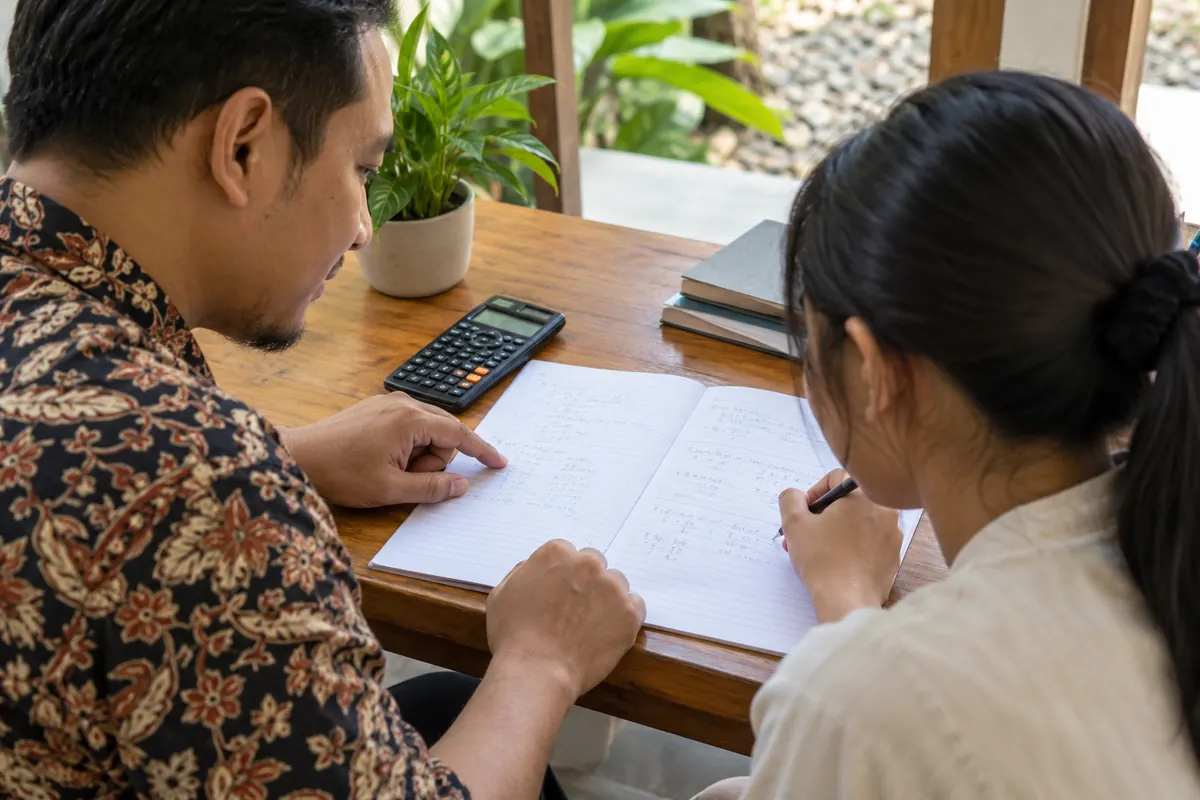
This generated photograph is illustrative. It does not show a real lesson, tutor, student or school.
Before calculating, check that both percentages describe the same measure and a comparable group. A class survey and a whole-school survey may use different denominators. Two percentages can also hide very different sample sizes, so include the counts when they matter.
Percentage change from a starting value of zero is undefined because division by zero is not possible. State the actual increase instead. If a value moves from 0 to 5, write that it increased by 5 units rather than inventing an infinite percentage.
Use a four-line working routine
On line one, record the old value and new value. On line two, calculate the signed difference. On line three, label whether the question asks for percentage points or change relative to the original. On line four, give the answer with its unit and direction.
Ask the student to explain the denominator in one sentence. If they can say, “I divided by 40 because 40% was the starting rate,” the arithmetic is connected to meaning rather than memorised as a floating formula.
Choose support without moving the commercial owner
For sustained help with number, algebra and data skills, the established maths tutoring service remains the commercial owner. This guide answers one informational question and does not replace that service page.
Families arranging face-to-face support around Tabanan can check the Tabanan tutoring area page for practical location planning and availability. For another place-value explanation, see why 0.8 is greater than 0.75.
Frequently asked questions
Is a rise from 20% to 30% a 10% increase?
It is a rise of 10 percentage points. Relative to the original 20%, the percentage increase is 50% because 10 divided by 20 equals 0.5.
Can I calculate percentage change from zero?
No. The usual calculation divides by the original value, and division by zero is undefined. Report the numerical increase and explain the context instead.
Related
Message us on WhatsApp: +62 858 6969 6869 · info@privatetutoringbali.com · We reply within one working day.
Sources and further reading
Published by Private Tutoring Bali. Sources and corrections.