Practical learning guide
Comparing decimals without counting the digits
Eight tenths is greater than seventy-five hundredths. This guide uses equal wholes, a place-value chart and a number line to help children explain why.

Start with the size of the whole
If a child says that 0.75 is greater than 0.8 because 75 is greater than 8, the answer reveals a useful starting point. They are applying a rule that works for whole numbers to a different kind of notation. Instead of correcting them with a rule to memorise, ask what each digit represents. The 8 means eight tenths, while the 75 means seventy-five hundredths.
Draw two equal squares. Divide one into ten equal strips and shade eight. Divide the other into one hundred equal small squares and shade seventy-five. The comparison is meaningful because the original wholes have the same size. Ask which shaded area is larger, then connect the picture to the written numbers. Keep the drawings available while the child explains the relationship in their own words.
This article concentrates on ordering decimal quantities. It is separate from our guide to common fractions mistakes, which explores equal parts and the meaning of the whole. A child who cannot yet identify tenths may need that foundation before comparing hundredths.
Make every digit say what it means
Write a chart with ones, tenths and hundredths. Place 0.8 in the chart, with zero ones and eight tenths. Place 0.75 beneath it, with zero ones, seven tenths and five hundredths. Compare from the largest place to the smallest. The ones match. At the tenths column, eight tenths exceeds seven tenths, so the comparison is already decided.
The extra five hundredths in 0.75 do not make another tenth. If your child is unsure, show the gap from 0.75 to 0.8 on the shaded grid. There are five hundredths between them. This is more informative than telling them that the shorter number happens to be bigger. The length of a decimal is not a reliable guide to its value.
Use a pair with different whole-number parts next: 2.09 and 1.98. Two whole units already exceed one whole unit plus a fraction of another. Comparing only the digits after the decimal point would miss that. Ask your child to locate both numbers between whole numbers before discussing the smaller parts.
Explain why adding a zero can help
Writing 0.8 as 0.80 makes both quantities expressible in hundredths. Eight tenths and eighty hundredths name the same amount. Now the comparison is eighty hundredths against seventy-five hundredths. The zero is a record of an empty hundredths position after eight tenths, not an instruction to make the value ten times larger.
Contrast this with 0.08. Here the eight has moved into the hundredths position, so the amount is eight hundredths. Ask the child to shade 0.8, 0.80 and 0.08 on equal grids, then match the equal pair. Do not extend the phrase 'zeros do not matter' to all positions. In 8.05, removing the zero would change the number to 8.5.
Try a small sorting task with 0.6, 0.06, 0.60 and 0.66. Put equal values together before ordering the groups. Invite an explanation for each decision. A correct sequence without an explanation can conceal a remembered trick; a clear explanation makes the child's understanding easier to see.
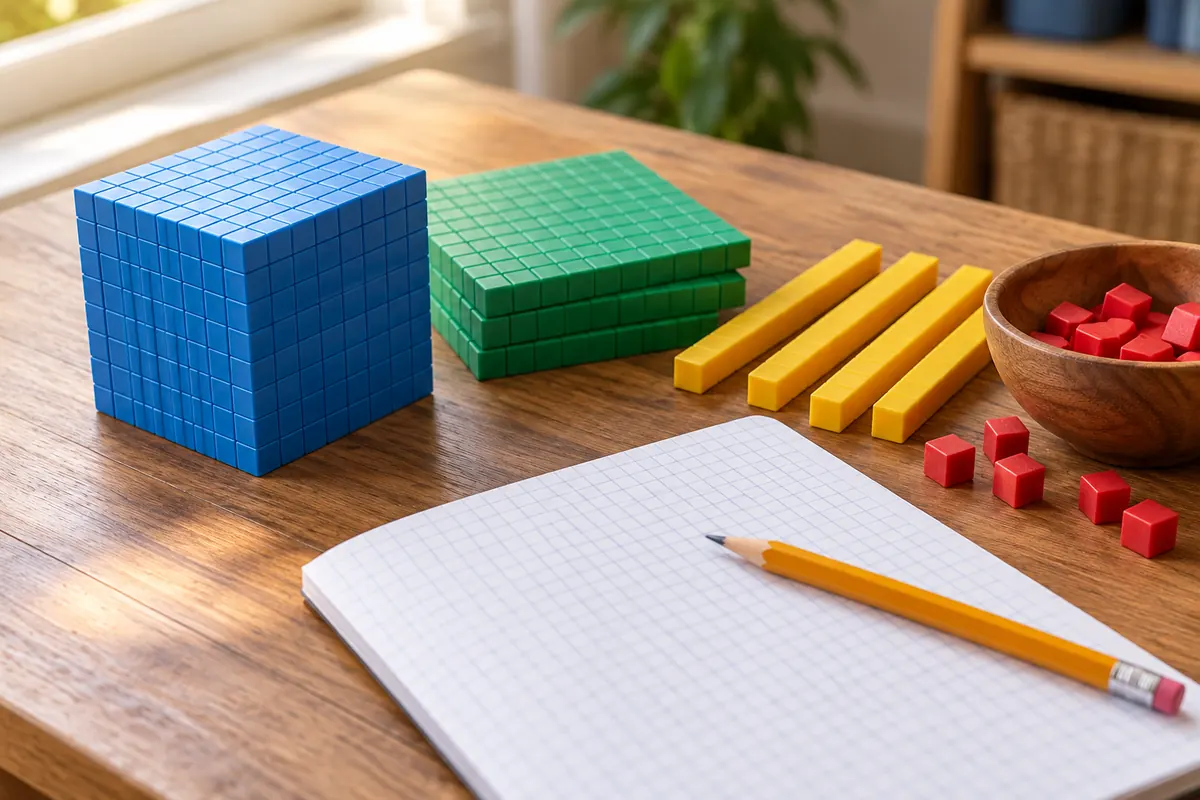
These AI-generated learning materials are illustrative. Use accurately divided grids and number lines for the worked comparisons.
Check the comparison on a number line
Draw a line from 0 to 1 and mark the tenths at equal intervals. Locate 0.7 and 0.8. The number 0.75 belongs halfway between them. This makes the comparison visible without a shaded-area model. Switching representations also helps you check whether the child understands the quantity rather than just recognising a familiar picture.
For a closer comparison, zoom into the interval from 0.4 to 0.5. Divide it into ten equal steps, each worth one hundredth. Place 0.43 and 0.47. Then ask where 0.45 belongs and which numbers lie on either side. Label the endpoints clearly: an enlarged drawing does not make the numbers themselves larger.
Use a ruler only if its units are understood. Mixing centimetres and millimetres without explaining the scale can add another difficulty. A simple hand-drawn number line with labelled endpoints is enough for discussing order.
Three original questions to discuss together
Question one: which is greater, 0.9 or 0.84? Nine tenths equals ninety hundredths, which exceeds eighty-four hundredths. Question two: put 1.05, 1.5 and 1.15 in increasing order. The order is 1.05, 1.15, 1.5, because all three have one whole and their fractional parts differ.
Question three: write a number between 0.31 and 0.32. One answer is 0.315. This introduces thousandths and should only be used when the child is comfortable dividing a hundredth into smaller equal parts. If they say no number fits, draw a larger interval and discuss how the scale could be subdivided.
Have your child invent a misleading pair for you to compare. Ask them to explain why someone might choose the wrong answer. Designing a counterexample can reveal whether they have moved beyond the idea that more digits always means more.
Turn an error into a focused support request
Keep one example showing the child's working and record the prompt that helped: a grid, a place-value chart or a number line. If they can explain the answer with a model but not with notation, that is a different next step from not recognising tenths at all. Share the distinction with the classroom teacher.
Our maths learning support page explains how to discuss the current topic and learning goal. Families arranging home sessions in Canggu can use the existing area page for practical enquiries. Include your child's year group, current curriculum and one representative decimal question, rather than asking for general revision of everything.
You can also explore number sense and mathematical reasoning for a broader view of representations. The next useful sign of progress is an independently explained comparison in a new example, not simply completing more of the same worksheet.
Frequently asked questions
Is 0.50 the same as 0.5?
Both represent five tenths, or fifty hundredths. A zero at the end of this decimal does not alter its value. Its position matters: 0.05 is five hundredths and is a different amount.
Should my child always add zeros before comparing?
Equivalent decimal forms can make a comparison clearer, but the child should explain why the quantities remain equal. Use a chart or drawing if adding zeros has become a rule they cannot justify.
Related
Message us on WhatsApp: +62 858 6969 6869 · info@privatetutoringbali.com · We reply within one working day.
Sources and further reading
Published by Private Tutoring Bali. Sources and corrections.