Building number meaning
How to move from maths counters to number symbols
The goal is not to put the counters away quickly. It is to help the learner recognise that the objects, the drawing, the spoken number and the written symbol represent the same mathematical idea.

Find out what the counters are doing for the learner
A child may use counters to keep track of a count, to see a quantity all at once, to combine two groups or to remember an operation. Do not remove the material until you know which job it is performing. Otherwise, the lesson can mistake taking support away for developing understanding.
Ask the child to build a small quantity, say how many there are and show how they know. Watch whether they count every object from one, recognise a familiar arrangement or organise an untidy group. The explanation reveals more than speed.
Use the same total in different arrangements. Six counters can appear as two rows of three, five and one, or an irregular group. If the child believes the number changes when the spacing changes, the immediate goal is quantity conservation, not writing equations.
The painted opening scene was generated to explain the idea. Both people are fictional, and the counters are illustrative rather than evidence from an assessment or tutoring session.
Connect each representation while the meaning is still visible
Place the written numeral beside the built quantity and say the number aloud. Then draw a quick representation, such as dots, circles or a bar. Point between them and ask what stays the same. The learner should experience the symbol as a name for the quantity, not as a separate fact to memorise.
The EEF recommends using manipulatives and representations purposefully and helping pupils understand the links between the material and the mathematical idea. Simply placing attractive equipment on the table is not enough. The adult’s questions and the learner’s explanations create the bridge.
Keep language consistent. Number six, six counters and the symbol 6 are connected descriptions. Avoid calling the written symbol an amount by itself when the child is still learning what it represents.
| Representation | What the learner does | Question that checks the link |
|---|---|---|
| Concrete | Builds six counters | How do you know there are six? |
| Drawn | Sketches six marks or a structured pattern | Where can you see the same quantity? |
| Spoken | Says six and explains the grouping | What stayed the same when the layout changed? |
| Symbolic | Matches or writes 6 | What does this symbol tell us about the group? |
Move in both directions, not along a one-way staircase
Show a quantity and ask for the symbol. Then show a symbol and ask the learner to build or draw it. This reverse direction matters because recognition and generation are different demands. A child may match 6 to six counters yet not know what to build when 6 appears alone.
Mix old and new examples so the learner must interpret rather than copy. Include two quantities that are easily confused and ask for a reason: how is six different from nine in this arrangement? The answer can use grouping, counting or comparison, provided the child can justify it.
Return to materials whenever a new operation or place-value idea needs them. Concrete representation is not a baby stage that a learner graduates from forever. Mathematicians use diagrams, models and notation flexibly because different representations reveal different relationships.
Fade the material by changing one part at a time
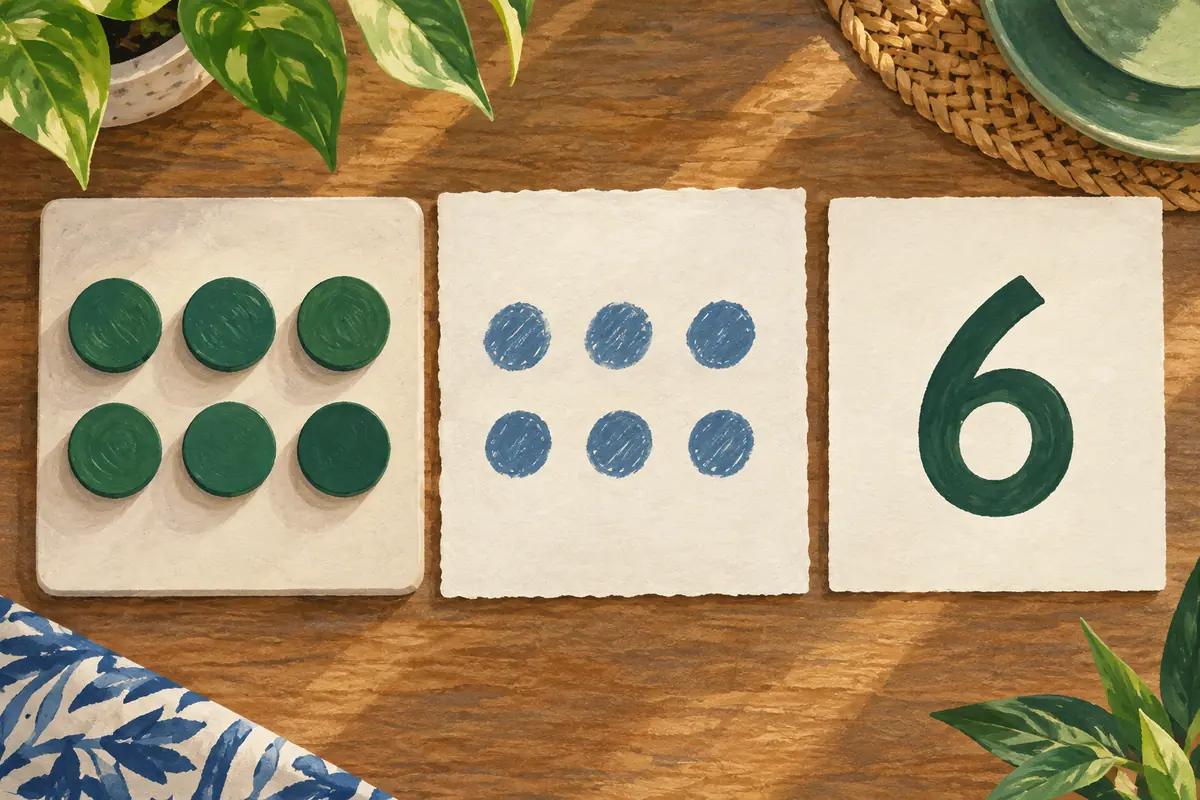
Generated editorial still life: all three panels show the same quantity. It is a visual explanation, not a diagnostic task.
Begin with counters available and used. Next, leave them available while inviting a drawing first. Later, hide the counters but allow the learner to request them. Finally, ask for a symbolic response and an explanation, then bring the counters back to check or correct the reasoning.
The right time to fade is when the learner can reconstruct the meaning, not when the adult is tired of the equipment. If errors increase, restore the previous representation and identify the broken connection. This is information, not failure.
Record the strategy and support, not only correct answers
Make a short note after a few comparable tasks: representation chosen, whether the child organised the quantity, prompt required and explanation given. Five correct answers built through full adult direction do not show the same independence as three accurate answers with self-chosen materials.
The number-sense guide explains how quantities, estimation and relationships develop across everyday maths. The article about writing 402 as 42 addresses a different place-value misconception; this guide stays with the bridge from quantity to symbol.
Seek the right support for persistent difficulty
Difficulty moving between representations can have many causes and does not establish dyscalculia. If a persistent pattern appears across school and home, share specific examples with the teacher or learning-support coordinator. Formal diagnosis belongs to appropriately qualified professionals.
Our dyscalculia-aware maths support teaches number concepts patiently but does not diagnose or treat a learning disorder. Families around Umalas can review the Umalas tutoring arrangements. The proposed tutor, travel and timetable are confirmed before lessons begin.
Frequently asked questions
Are fingers a problem if my child still uses them?
Fingers are a readily available representation and can support useful reasoning. The key question is whether the child understands the quantity and is developing more efficient strategies, not whether their hands are hidden. Ask the teacher how finger use fits the current learning goal.
Should I remove counters once answers are correct?
Check whether the child can explain the connection, build from a symbol and solve a comparable example without adult direction. Leave materials available as a checking tool and fade their use gradually. Correct answers alone do not reveal how secure the concept is.
Related
Message us on WhatsApp: +62 858 6969 6869 · info@privatetutoringbali.com · We reply within one working day.
Sources and further reading
Published by Private Tutoring Bali. Sources and corrections.