ADHD-aware study support
How to make homework time visible for a child with ADHD
A clock shows the time of day, but it does not automatically show how long a task may take or when to change course. Externalise those decisions, then teach the child to use them.

Separate starting, working and finishing
Homework time often becomes one vague block. The child hears that it is time to work but cannot see whether the task will take ten minutes or an hour, where the difficult part sits or what finished means. Make those three moments explicit before adding a timer.
Starting is the first visible action. Working is a short period with one defined task. Finishing is either completing the agreed outcome or reaching a planned checkpoint and deciding what comes next. A child can improve at one stage while still needing support at another.
This guide assumes the assignment is available and understood. If the difficulty is beginning at all, use the separate guide to starting homework without constant reminders. The focus here is representing time after the task has been opened.
The opening scene is an AI-generated illustration, not a photograph. The learner, adult and home are invented and do not portray a client, staff member or clinical intervention.
Estimate first, then treat the estimate as a question
Ask the child to estimate how long one defined piece will take, then make your own estimate without arguing about whose is correct. Ten mixed algebra questions is more estimable than maths homework. Reading one section and noting three key points is more estimable than study science.
Write the estimate where both of you can see it. When the period ends, compare the estimate with what happened. The purpose is calibration, not catching the child out. A task may take longer because instructions were unclear, a skill was missing, the platform failed or the estimate was simply new.
Use broad categories for younger learners: short, medium or long. Older children can use minutes, but avoid false precision. Repeatedly estimating and reviewing comparable tasks is more useful than an adult announcing the correct duration.
| Before the block | At the checkpoint | After the block |
|---|---|---|
| Name one task and estimate its length | Notice progress without judging pace | Compare estimate, support and result |
| Choose what finished will look like | Continue, adjust or ask for clarification | Use the evidence for the next estimate |
| Remove avoidable distractions | Use the planned prompt only if needed | Record one useful pattern, not a score |
Choose a timer that informs rather than threatens
A visual timer can show elapsed and remaining time without requiring repeated clock calculations. Introduce it when the child is calm. Let them handle it, watch a short practice interval and agree what the signal means before using it during demanding work.
The signal should mean pause and review, not you failed to finish. At the checkpoint, ask: is the task clear, are we making progress and what is the smallest sensible next step? Sometimes the right decision is another block. Sometimes it is to request missing information or stop an unproductive struggle.
CDC guidance describes organisational training as including time management, planning and ways to manage school materials. A timer is only one external tool inside that wider teaching process. It does not replace explicit instruction, appropriate adjustments or support from school and health professionals.
Use three cards to make the block predictable
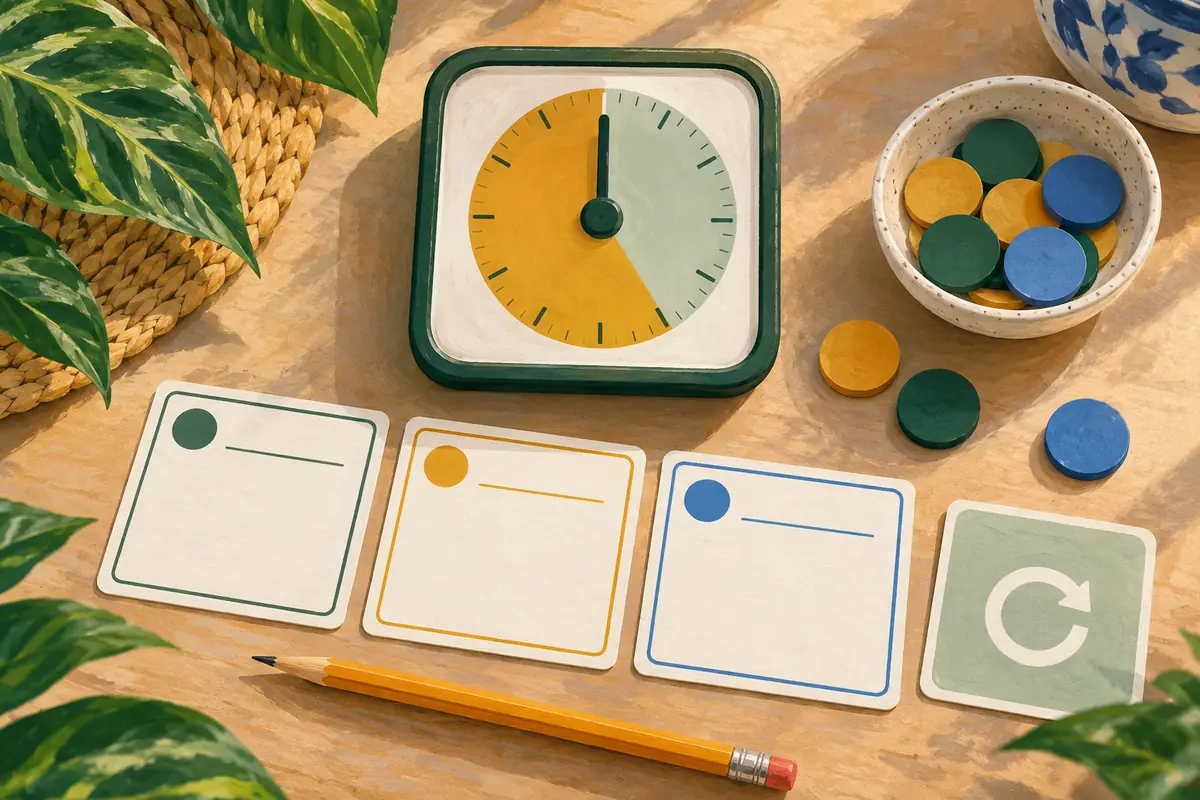
Generated editorial still life: the cards contain no instructions because families should use wording and symbols the child already understands.
Card one names the task. Card two names the checkpoint. Card three shows what happens next: a break, another block or packing the work for school. Keep the sequence small enough to scan at a glance. A detailed planner can become another task when the child is already overloaded.
If the child needs a reminder, point to the current card before adding new language. If the system works only while an adult narrates every minute, the adult remains the timekeeping system. Gradually hand over one action, such as setting the timer or choosing the checkpoint, while keeping the rest stable.
Review patterns without monitoring every movement
For one or two weeks, record only the task type, estimate, actual block length, highest prompt used and next decision. Do not record every distraction. The useful question is whether the learner is becoming better at planning and recovering, not whether attention looked perfect.
Compare like with like. A familiar ten-question practice set and an unfamiliar research task are not equivalent. Look for repeatable information: written instructions may reduce clarification time, a particular time of day may be more workable, or a twenty-minute block may consistently be too long after school.
The predictable learning routines guide covers the wider day. The multi-step task guide explains how to reveal hidden actions inside a complex assignment.
Keep educational support within its proper boundary
For an existing diagnosis or school plan, use strategies that agree with the child’s teachers and qualified professionals. If attention, distress or daily functioning is a broad concern, seek appropriate assessment rather than using a homework log to label the child.
Our ADHD-aware tutoring support focuses on learning routines, organisation and schoolwork. Tutors do not diagnose or treat ADHD. Families around Seminyak can review the Seminyak tutoring arrangements; tutor fit, travel and availability are confirmed before booking.
Frequently asked questions
What if a timer makes my child more anxious?
Stop using it as a countdown. Try a non-numeric progress strip, a quiet checkpoint card or an adult-managed timer that only signals a review. A tool that increases distress is not serving the learning goal; discuss persistent concerns with school and qualified professionals.
Should homework blocks always be the same length?
Consistency can make the routine predictable, but task demands and the child’s state still matter. Begin with a workable range, compare similar tasks and change the length using evidence rather than extending it because work remains.
Related
Message us on WhatsApp: +62 858 6969 6869 · info@privatetutoringbali.com · We reply within one working day.
Sources and further reading
Published by Private Tutoring Bali. Sources and corrections.