Homeschool planning skills
How to keep a useful homeschool learning record
Choose a small number of dated samples that show what the learner attempted, what changed and what should happen next, rather than archiving every worksheet.
Published

Decide what the record is for
A useful learning record helps a family plan, helps the learner notice progress and gives a future teacher or adviser enough context to understand recent work. Those purposes do not require a photograph of every activity or a daily score for every subject.
Start with the family’s curriculum, qualification route and any local reporting obligations. Home-education rules vary by country, so families should check the requirements that apply to them. A portfolio can support that process, but this guide is an organisational method rather than legal advice.
The opening portfolio photograph is AI-generated with fictional Indonesian people. It does not show a real tutor, learner, school or client record.
Record four pieces of context
For each selected sample, note the date, learning focus, level of support and next step. “Fractions worksheet” tells a future reader very little. “Compared fractions with unlike denominators; used a visual model independently; next step is explaining the common denominator” is much more useful.
Keep the learner’s original attempt when possible. A polished final copy can show achievement, while an early attempt and correction can show the learning process.
| Record field | Useful detail | Avoid |
|---|---|---|
| Date and focus | When the work happened and the exact objective | A folder of undated pages |
| Level of support | Independent, prompted, modelled or completed together | Presenting guided work as independent |
| Evidence | One representative sample, photograph or observation note | Saving every repetitive exercise |
| Next step | The specific skill to revisit or extend | A vague label such as needs more practice |
Choose evidence across different kinds of learning
Written work is only one form of evidence. A photograph of a model, a short reading note, an audio recording, a project plan or a parent observation can show learning when the activity does not produce a worksheet. Protect privacy and avoid including other children without permission.
Across a month, aim for a balanced picture: knowledge, application, communication and reflection. The record should also show interests and practical learning, not only the easiest items to grade.
Let the learner add a short reflection
Ask the learner to answer one or two questions: What was difficult? What strategy helped? What would you change next time? A young child can answer verbally while an adult records a sentence. An older learner can add the note independently.
Reflection should not become another long assignment. Its purpose is to reveal how the learner understands the work and to guide the next learning decision.
Review the portfolio at a fixed interval
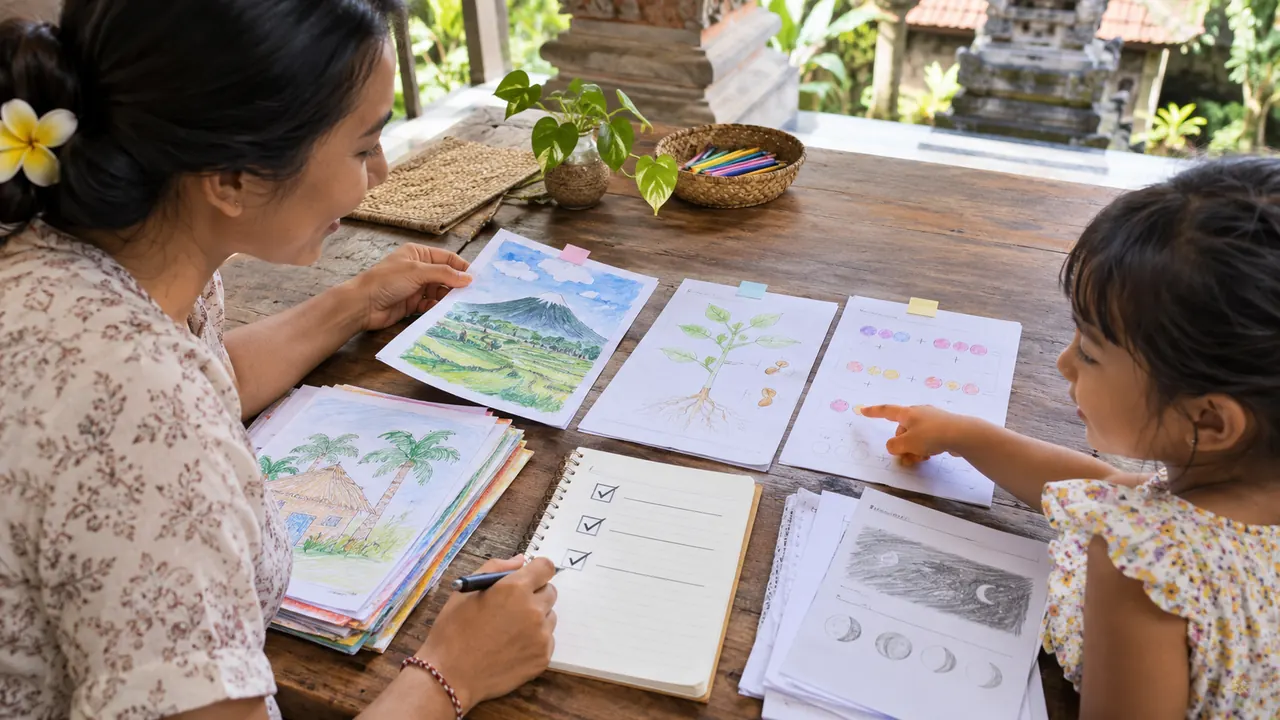
This portfolio image is AI-generated with fictional people and does not document an actual homeschool programme.
Set a weekly or fortnightly review. Remove duplicates, add missing context and compare the newest evidence with an earlier sample of the same skill. Look for a sequence of progress rather than a collection of perfect products.
Use the review to choose the next objective. If the evidence is unclear, plan a small task that reveals what the learner can do without excessive support.
Get help planning homeschool learning
If a family needs help connecting objectives, lessons and evidence, bring the current curriculum and a few recent samples to a homeschool tutoring discussion. The commercial homeschool page owns service enquiries; this guide focuses on record keeping.
Families around Gianyar can also review the Gianyar tutoring area page. The homeschool lesson-planning guide explains how to turn one objective into a teachable sequence.
Frequently asked questions
Does a homeschool portfolio need every piece of work?
No. A smaller set of dated, representative samples with context, support level and next steps is usually more useful for planning than an unfiltered archive.
How often should a homeschool record be reviewed?
A weekly or fortnightly review is practical for many families. Choose an interval that is regular enough to guide the next plan without turning documentation into the main activity.
Related
Message us on WhatsApp: +62 858 6969 6869 · info@privatetutoringbali.com · We reply within one working day.