Homeschool lesson planning
How to turn a curriculum objective into a homeschool lesson
Start with what the learner should understand or do, not with an attractive activity. Then choose one experience that makes the objective visible and one brief check that shows what to teach next.

Read the objective as a destination, not a worksheet instruction
A curriculum objective usually describes knowledge, understanding or a skill. It does not tell you that the child must complete a particular worksheet, watch a particular video or spend a fixed number of minutes at a table. Those are possible teaching choices, not the destination.
Underline the action in the objective. Words such as identify, compare, explain, calculate and justify ask for different evidence. A child may identify two features correctly without yet being able to explain why they matter. Planning becomes clearer when the action stays visible.
Also confirm the curriculum, year level and sequence. Similar topics appear at different levels with different expectations. The Australian Curriculum, for example, separates content descriptions from achievement standards: one describes what is taught, while the other describes the expected quality of learning. Use the documents your programme or next school actually follows.
This opening image was generated for this guide. Its adult, child, home and learning materials are imagined; none represents a family, tutor or guaranteed teaching method.
Rewrite the objective as one observable lesson outcome
Translate the formal wording into a sentence the learner can understand without changing its level. A useful frame is: by the end, you will be able to do this, using this kind of example, and show it in this way.
Suppose the curriculum objective concerns comparing how leaves are adapted to different environments. The lesson outcome could be: compare two leaves, name two visible differences and explain how one difference may suit each environment. That outcome is narrower than a whole unit, but richer than collecting leaves.
Avoid outcomes such as understand plants or learn fractions. They cannot be checked in one lesson. Avoid making the evidence too large as well. A polished poster can consume the lesson while concealing whether the child can explain the central idea.
| Planning layer | Useful question | Leaf example |
|---|---|---|
| Curriculum objective | What knowledge or skill is expected? | Compare visible adaptations |
| Lesson outcome | What should the child do today? | Compare two leaves and explain one difference |
| Evidence | What would make the learning visible? | A labelled sketch plus a spoken explanation |
| Next decision | What will the evidence tell us? | Practise observation or deepen the explanation |
Check what the learner already knows before choosing the activity
Ask two or three quick questions, show a simple example or invite the child to explain the topic. This is not a formal pre-test. It prevents a lesson that repeats secure knowledge or assumes vocabulary the child has never met.
Listen for the reason behind an answer. If the child can name parts of a leaf but cannot compare them, the lesson should model comparison language. If the comparison is already strong, the challenge may be evaluating which observation supports a claim.
Homeschool planning is especially vulnerable to resource-first decisions because families have access to so many books, apps and excursions. A useful activity earns its place by revealing or strengthening the objective. Interesting is valuable, but interesting and aligned is better.
Build a short lesson around model, attempt and explanation
A dependable sequence is: orient the learner, model one example, let the learner attempt a comparable example, then ask for an explanation. The exact timings depend on age, prior knowledge and the task. A younger child may move between objects and talk; an older student may annotate a text or solve a problem independently.
Model the thinking, not only the finished product. You might say: I notice the waxy surface, so I am considering whether it helps retain water. I need evidence before I decide. This exposes the decisions that a completed answer hides.
Then hand the work back. If the learner is stuck, give the smallest prompt that allows progress. The EEF recommends explicit teaching, modelling and scaffolding of planning, monitoring and evaluation, with support gradually transferred to the learner rather than removed without preparation.
Keep one piece of evidence that answers a real question
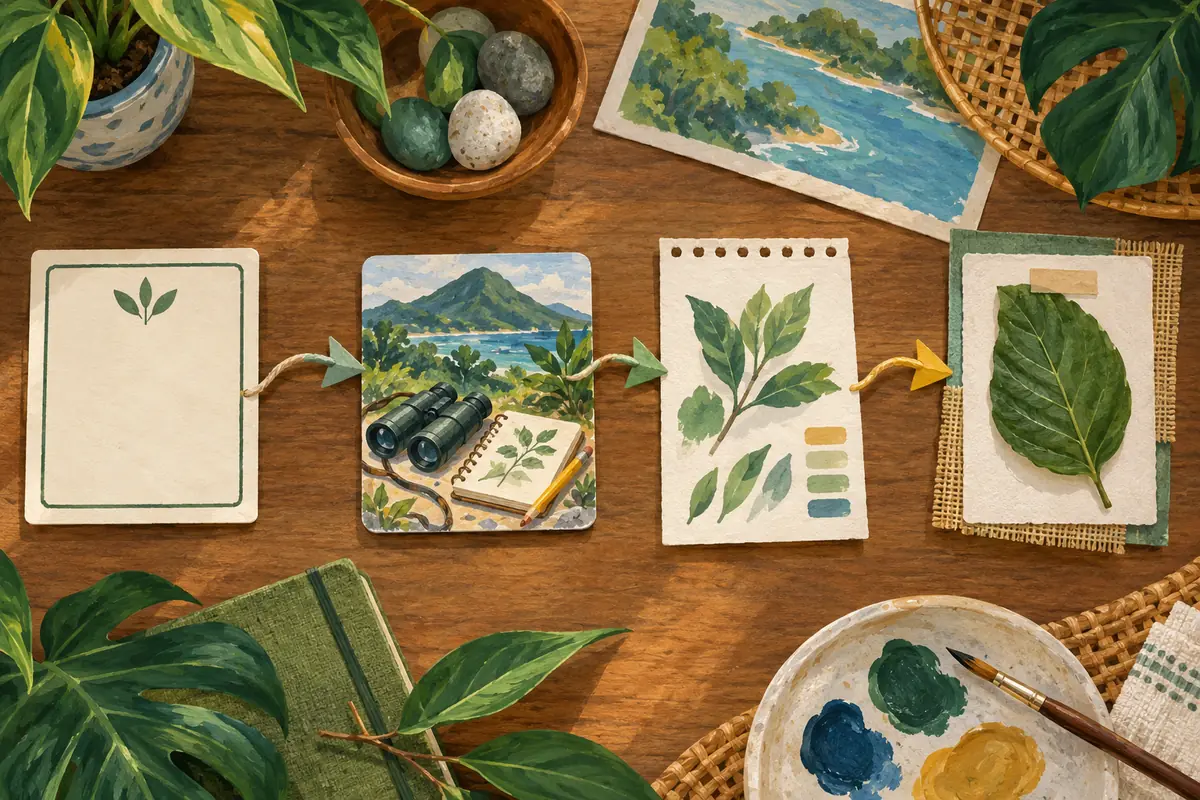
Generated editorial still life: the cards are blank and the materials are fictional. It illustrates a planning sequence, not a prescribed curriculum resource.
Choose evidence that is proportionate to the objective: a photographed model with the child’s explanation, three worked examples, a short paragraph, a labelled diagram or an audio reflection. Record the date, objective and level of help. That final detail distinguishes independent learning from work completed through heavy prompting.
The evidence should answer one planning question. Is the concept secure? Is vocabulary blocking the explanation? Can the child apply the idea to a new example? Save the minimum needed to answer that question, then use the answer to plan the next lesson.
For a simple term-long record, see the homeschool learning portfolio guide. The wider homeschooling and worldschooling hub covers programme choices, routines and transitions.
Know when a planning partner would help
If lesson activities are enjoyable but the sequence feels disconnected, bring the curriculum document, recent work and the learner’s next transition point to a planning conversation. A homeschool teacher in Bali can work within a parent-led programme, but the family still needs to confirm any legal, accreditation or school-entry requirements with the relevant provider and authority.
Families based around Ubud can review the Ubud tutoring arrangements. Availability, travel and programme fit are confirmed before booking. We do not promise that one lesson format suits every curriculum or learner.
Frequently asked questions
How many curriculum objectives should one homeschool lesson cover?
Often one clear objective is enough, especially when a concept is new. Closely connected knowledge may sit underneath it, but combining several unrelated objectives makes the evidence hard to interpret. Let the learner’s response determine whether to extend or stop.
Does every homeschool lesson need written work?
Evidence can be spoken, practical, visual or written, provided it genuinely demonstrates the intended learning. Keep a short record of what the child did and how much support was required when that information will inform later planning.
Related
Message us on WhatsApp: +62 858 6969 6869 · info@privatetutoringbali.com · We reply within one working day.
Sources and further reading
Published by Private Tutoring Bali. Sources and corrections.