Early years number sense
How to help a child count objects accurately
Slow the task down so one number word matches one object, then help the child understand that the last number names the size of the whole group.
Published

Notice which part of counting is difficult
Reciting number words and counting a group are related but different. A child may say the sequence correctly while touching one object twice, skipping an object or moving faster than the spoken words. Another child may coordinate each object well but lose the number-word order.
A third step is understanding cardinality: the final number said tells how many objects are in the group. If a child recounts every time an adult asks how many, that may show the final-number idea is still developing rather than carelessness.
The opening photograph is an AI-generated editorial illustration with fictional Indonesian people. It does not show a real child, teacher, lesson or early-years setting.
Arrange objects so each one can be counted once
Begin with a small group that the child can physically move. Place mixed objects in one area and ask the child to slide each counted object into a row or a second area. Movement creates a visible record of what has already been counted.
Use familiar objects such as shells, buttons or toy animals, provided they are safe for the child’s age. Change the arrangement after a successful count so the learner discovers that spreading the same group out does not change how many objects it contains.
- Say one number word for one touched or moved object.
- Keep the spoken pace slow enough to match the hand movement.
- Pause after the last object and repeat the total as a complete sentence.
- Check the same group in a new arrangement rather than adding more objects immediately.
Model the process without taking over
If objects are skipped, demonstrate with a smaller set and exaggerate the one-touch, one-word rhythm. Then return the objects and let the child try. Avoid holding the child’s hand through every count because the adult movement can hide what the learner controls independently.
When the child makes an error, ask where the count became uncertain. Recount together once, then offer a fresh attempt. Frequent, low-pressure experiences are more useful than turning one mistake into a long correction.
Make the total visible in play
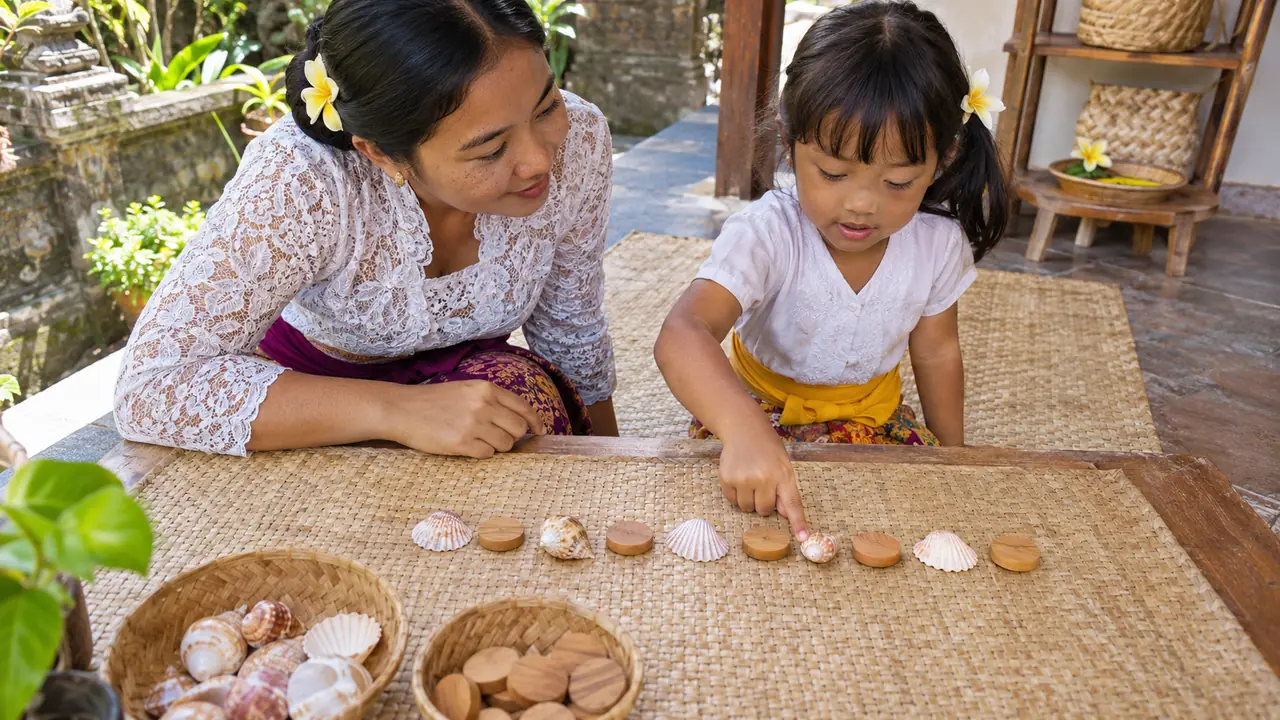
This supporting image is AI-generated with fictional people. The learning materials illustrate a counting routine and do not document an actual lesson.
After the child counts, ask for the total without moving the objects again: “You said seven last. How many are there?” Then use that total in a purpose, such as giving seven toy animals one food counter each or checking whether two plates have the same number.
Small patterns can also be recognised without counting one by one. Let subitising and object counting support each other: recognise a small group quickly, then count when the group is larger or the arrangement is unfamiliar.
Increase difficulty one feature at a time
Add more objects only when the current group can be counted reliably. Later, try objects that cannot be moved, objects in a circle, or a mixed collection with different sizes. Changing one feature at a time reveals whether the child understands the counting principle or remembers one arrangement.
Stop before concentration collapses. A two-minute counting game during ordinary play can provide clearer evidence than a long worksheet, especially for a child who is still coordinating speech, attention and movement.
Connect home practice with the early-years programme
If a child can recite numbers but cannot yet coordinate objects, totals and written numerals, share one concrete example when asking about early-years tutoring support.
Ubud families can review local lesson arrangements on the Ubud tutoring page. For a later representation step, see how to move from counters to number symbols.
Frequently asked questions
Should I correct every skipped number immediately?
Keep the task positive and make the mismatch visible. Model a smaller group once, then let the child retry so you can see what they can coordinate independently.
Why does my child recount when I ask how many?
They may not yet trust that the final number spoken represents the total. Repeat the last number as the group size and use that total in a simple play purpose.
Related
Message us on WhatsApp: +62 858 6969 6869 · info@privatetutoringbali.com · We reply within one working day.