Chess rules and decision making
How to get out of check in chess
Find every attack on the king, then test whether a legal move can move the king, capture the attacker or block the line of attack.
Published

Confirm that the king is actually in check
A king is in check when an opposing piece attacks its square. Before looking for a response, identify the checking piece and trace its route to the king. A rook, bishop or queen may attack along a line; a knight, pawn or adjacent king attacks in its own pattern.
FIDE rules do not allow a move that leaves the player’s king in check or exposes it to a new attack. A move that looks active elsewhere on the board is irrelevant until the immediate threat has been removed.
The opening chess photograph is AI-generated with fictional Indonesian people. It is an editorial illustration, not a record of a real tutor, learner, lesson or school relationship.
Test the three response categories
Most single checks can be answered in one of three ways: move the king to a safe square, capture the checking piece, or place a piece between the attacker and king. Treat these as categories to investigate, not a promise that each option exists in every position.
After choosing a candidate, imagine the board after the move. Check every opposing rook, bishop, queen, knight, pawn and king that could attack the destination or reveal a line. The response is legal only if the king is then safe.
| Possible response | Question to ask | Important limit |
|---|---|---|
| Move the king | Is the destination unattacked? | The king cannot move next to the opposing king |
| Capture the attacker | Can the capturing piece do so legally? | The capture must not uncover another check |
| Block the line | Is there a square between attacker and king? | Knights, pawns and adjacent pieces cannot be blocked |
Move the king only to a safe square
Mark the king’s neighbouring squares, remove occupied squares that cannot be captured, then remove every square attacked by the opponent. Remember that a pinned opposing piece may still affect whether the king can capture it, so examine the complete position rather than relying on appearance alone.
The king may capture the checking piece if the destination is not defended. Physically removing the attacker does not make the move legal when another enemy piece covers that square.
Capture or block without overlooking a second line
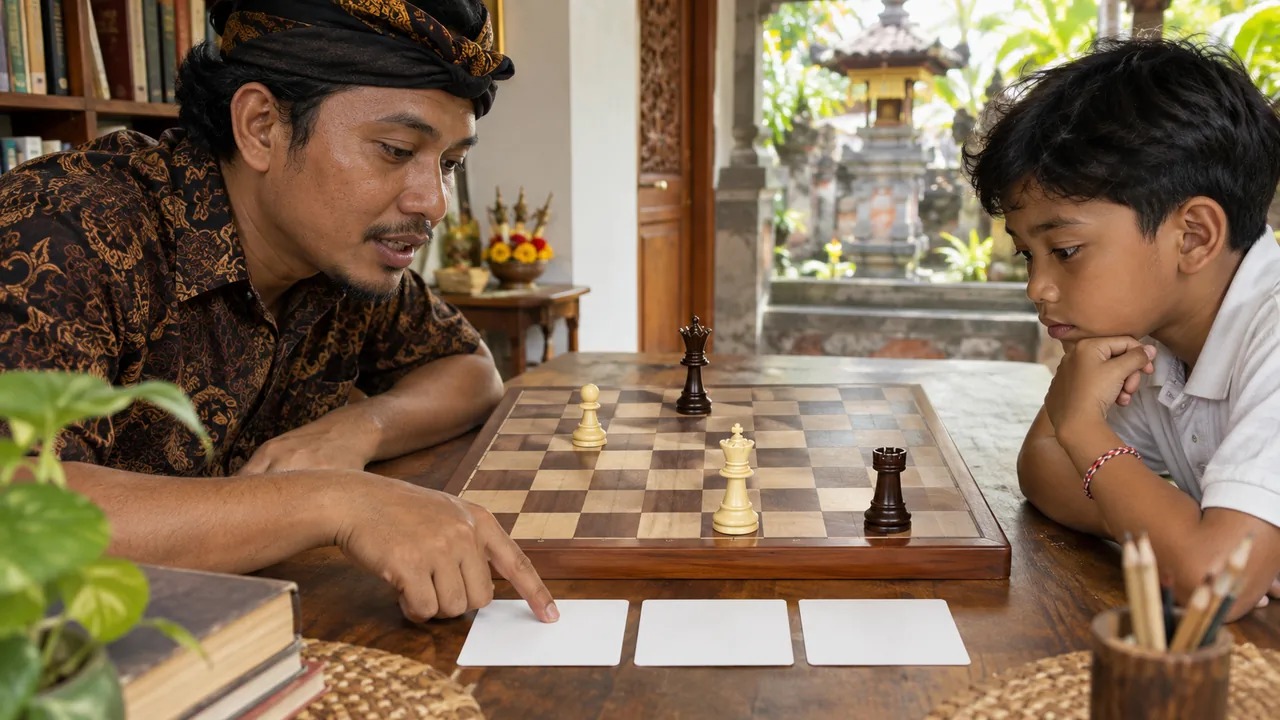
This supporting photograph is an AI-generated editorial illustration with fictional people and a practice position. It does not depict a real lesson or rated game.
A different piece can capture the checker if that move leaves the king safe. When a rook, bishop or queen checks from a distance, a defender may also move onto one of the squares between attacker and king.
Blocking is impossible against a knight check because the knight does not travel along the intervening squares. In double check, moving the king is the only response because a non-king move cannot remove both attacks in a legal double-check position.
Use a repeatable board routine
Ask the learner to point to the king, point to each checking piece and say the attack line aloud. Then list candidate responses under move, capture and block before touching a piece. This slows impulsive play without giving away the move.
Finish every candidate with the same question: after this move, who attacks my king? If no legal response survives, the position is checkmate. If the king is not in check but the player has no legal move, that is stalemate instead.
Practise chess decisions with feedback
Children who know how pieces move but miss checks often need short, repeated position practice. A chess tutoring discussion can focus on legal-move checks, notation and planning.
Families on the Bukit can see local arrangements on the Uluwatu tutoring page. For the different end-position question, compare stalemate and checkmate for children.
Frequently asked questions
Can another piece block a knight check?
No. A knight jumps directly to its attacked square, so there is no line to block. The king must move, the knight must be captured, or the position is checkmate.
Can the king capture the piece giving check?
Yes, but only if the destination square is not attacked by another opposing piece and the move obeys all other legal-move rules.
Related
Message us on WhatsApp: +62 858 6969 6869 · info@privatetutoringbali.com · We reply within one working day.