Sentence editing
How to fix a comma splice in three reliable ways
When a comma joins two complete sentences by itself, use a full stop, a semicolon or a suitable conjunction to make the relationship clear.
Published

First prove that both sides can stand alone
A comma splice happens when two independent clauses are joined with only a comma. An independent clause expresses a complete thought and can stand as a sentence. In “The rain stopped, we returned to the court,” both “The rain stopped” and “We returned to the court” pass that test.
Not every comma between verbs is a splice. “When the rain stopped, we returned to the court” begins with a dependent clause, so the comma is doing a different job. Read each side aloud as a separate sentence. If both sound complete, check how they are joined.
The opening AI-generated editing scene contains fictional Indonesian people; they are not members of our team or learners we teach.
Repair one: use a full stop for two clear statements
The safest repair is often two sentences: “The rain stopped. We returned to the court.” This works when each idea deserves its own emphasis or when a long sentence is becoming difficult to follow.
Do not assume that a shorter sentence is less sophisticated. Clear control matters more than length. A paragraph with varied, accurate sentences is easier to read than one that joins every idea with commas.
Repair three: add a conjunction that matches the logic
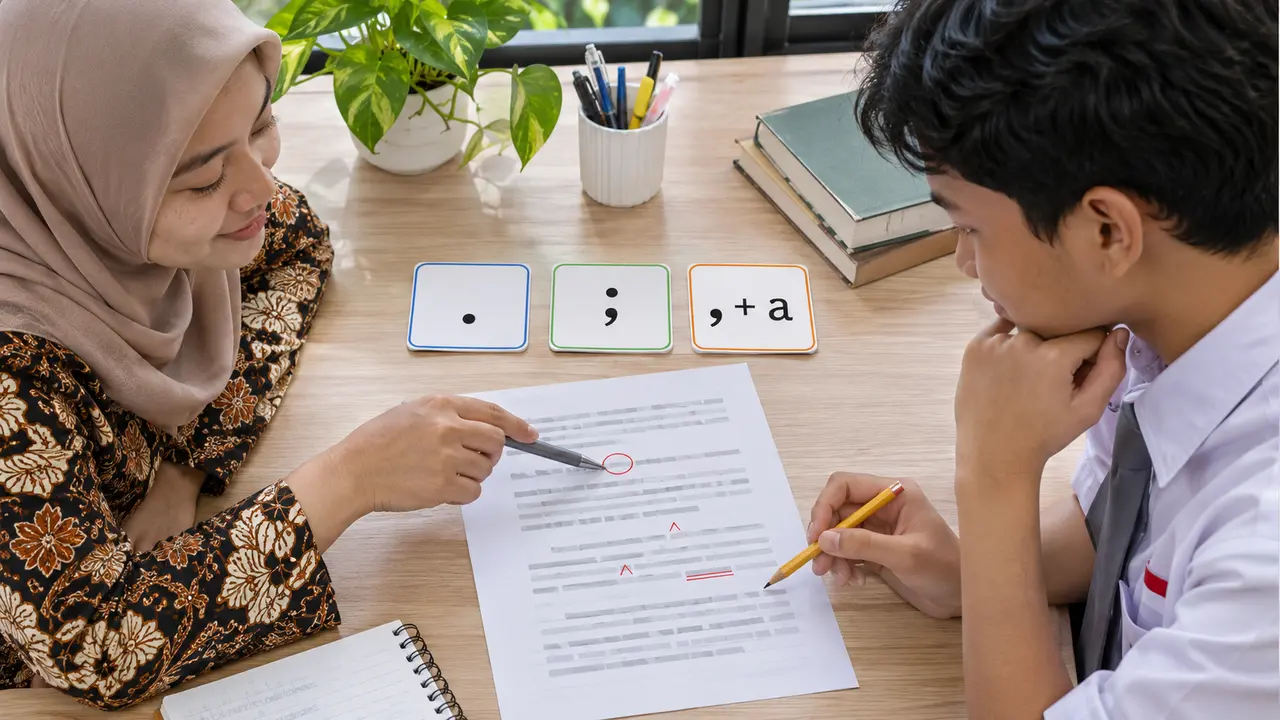
The punctuation-card photograph was generated for this explanation and portrays no real class, tutor, student or partner.
A coordinating conjunction can state the relationship: and adds, but contrasts, or offers an alternative, and so shows a result. Write a comma before the conjunction when it joins two independent clauses: “The rain stopped, so we returned to the court.”
Choose for meaning rather than inserting and automatically. If the second clause explains why, a subordinating conjunction may work better: “We returned to the court because the rain had stopped.” This changes the sentence structure, so punctuation changes too.
Use one proofreading pass just for sentence boundaries
Proofreading everything at once is demanding. On one pass, ignore spelling and look only at full stops, semicolons and commas. For every comma, ask whether the words on both sides could be sentences. Mark possible splices, then choose the repair that expresses the intended relationship.
Reading aloud helps reveal a rushed boundary, but pauses alone are unreliable because speakers pause for many reasons. The grammatical test is stronger: identify the subject and finite verb on each side, then ask whether each clause completes a thought.
Get help building control, not polishing one assignment
If a learner repeatedly joins complete thoughts with commas, bring a short sample they wrote themselves to a writing tutoring discussion. The useful goal is to recognise and repair the pattern independently, while the student remains the author of assessed work.
Families arranging sessions around Kuta can review the Kuta tutoring area page. For a paragraph-level editing routine, see how to keep tense consistent.
Frequently asked questions
Is a comma splice the same as a run-on sentence?
A comma splice is one type of run-on: two independent clauses are joined with only a comma. A fused sentence joins them with no punctuation at all.
Can I always fix a comma splice with a semicolon?
A semicolon works when both sides are complete sentences and their meanings are closely related. A full stop or a conjunction may express the intended relationship more clearly.
Related
Message us on WhatsApp: +62 858 6969 6869 · info@privatetutoringbali.com · We reply within one working day.