Editing a paragraph
How can a child keep tense consistent in a paragraph?
Choose the paragraph timeline, underline the verbs that carry time and change only shifts that do not have a reason.

Consistency does not mean every verb looks the same
A narrative may mainly use the past tense and still include dialogue in the present tense. A factual paragraph may use the present for a general truth and the past for a completed experiment. The aim is a clear timeline, not a rule that bans every change.
Begin by asking when the main events happen. Write PAST, PRESENT or FUTURE above the paragraph. That label gives the child a reference for checking each main verb without asking an adult to rewrite the sentences.
The opening photograph is AI-generated. The fictional Indonesian teacher and child are not our staff or a client, and the setting is not a partner school.
Read a short example as a timeline
Consider this draft: “Maya opened the gate and walks into the garden. She heard a noise, so she looks behind the tree.” The first verb, opened, places the sequence in the past. Walks and looks shift into the present without a reason.
A consistent version is: “Maya opened the gate and walked into the garden. She heard a noise, so she looked behind the tree.” The meaning stays the same, but the reader no longer has to rebuild the timeline mid-sentence.
Use a three-pass edit
| Pass | What the child does | Question |
|---|---|---|
| 1. Timeline | Labels the main time of the paragraph | When is this happening? |
| 2. Verbs | Underlines verbs that carry the action or state | Which word tells the time? |
| 3. Reason | Checks every shift before changing it | Did the time really change here? |
Keep shifts that communicate real meaning
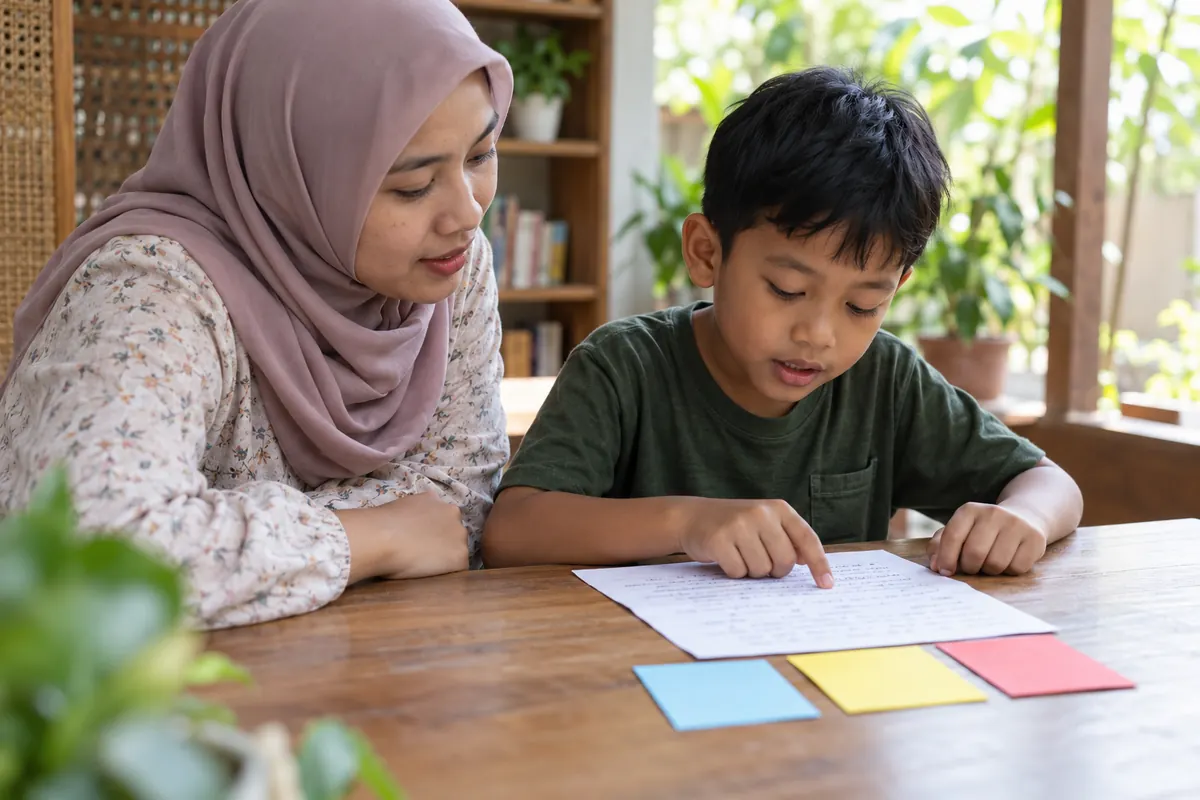
This generated image illustrates a tense timeline. It is not a real lesson or a photograph of Private Tutoring Bali staff.
The sentence “Yesterday I visited the reef, and I still remember the bright blue fish” moves from a completed visit to a present memory. The change has a reason. Dialogue can also carry its own time: “I am ready,” Rani said. Am is present inside the spoken words while said belongs to the past narrative.
Ask the child to add a time marker such as yesterday, now or next week only when it improves meaning. Filling every sentence with markers can make the writing heavy. The timeline label and verb check should do most of the work.
Do not edit meaning and punctuation at the same time
First check whether the ideas are complete and ordered. Next check tense. Leave spelling and punctuation for a later pass. Separating the decisions reduces the chance that a child fixes a comma while missing a sentence that jumps between times.
Let the child read the revised paragraph aloud and point to the word that justifies each intentional shift. If the explanation is only “it sounds better,” compare the events on a simple before, now and after line.
Route broader English support to its owner
The established English tutoring page owns the broader service intent for reading, writing and language support. This editing guide stays focused on one paragraph-level question.
Families seeking in-person arrangements near Umalas can use the Umalas tutoring page. For the earlier planning stage, help a child plan a clear paragraph separates idea selection from sentence editing.
Frequently asked questions
Must a whole story stay in one tense?
A story usually keeps a stable main narrative tense, but dialogue, memories and comments about the present can create meaningful shifts. The reader should be able to explain why the time changed.
Which verbs should my child underline?
Start with the finite verb in each clause, the verb that carries tense or works with an auxiliary. The activity does not require labelling every word before the timeline can be checked.
Related
Message us on WhatsApp: +62 858 6969 6869 · info@privatetutoringbali.com · We reply within one working day.
Sources and further reading
Published by Private Tutoring Bali. Sources and corrections.