Physics problem solving
How to draw a force diagram correctly
Choose the object first. Identify every interaction acting on that object, draw one labelled arrow for each force and keep motion information separate.
Published

Decide which object the diagram describes
A force diagram represents forces acting on one chosen object. Draw that object as a simple box or dot and state what it represents. If the situation contains a book, a table and a hand, do not mix forces acting on all three into one diagram.
Then list the interactions involving the chosen object. Gravity comes from the interaction with Earth. A table can exert a normal contact force. A hand, rope, spring, air or rough surface may exert other forces. Each arrow must have an identifiable source.
This opening image is an AI-generated force-diagram illustration with fictional Indonesian people. It does not document a tutor, learner, classroom, client relationship or school affiliation.
Draw force arrows from the object
Start every force arrow at the box or dot and point it in the direction the force acts. A vertical downward arrow can represent weight. A perpendicular arrow from a surface can represent a normal contact force. Friction acts along a contact surface and opposes relative motion or the tendency to slide.
Use the arrow length to compare force magnitudes when the question provides enough information. Equal opposite arrows can show balanced forces. Do not claim exact equality from a rough sketch unless the situation or calculation justifies it.
| Diagram feature | What it communicates | Common error |
|---|---|---|
| Chosen object | The body whose forces are shown | Combining forces on several objects |
| Arrow direction | Direction of the force on that object | Drawing the object’s path instead |
| Arrow label | Force type and, when useful, its agent | Using an unexplained letter |
| Arrow length | Relative magnitude when evidence supports it | Making every arrow equal by habit |
Name the force and its agent
Labels such as “push” or “support” can be too vague. Use the course terminology, and add the agent when confusion is possible: force of the table on the book, tension from the rope or drag from the air.
Weight is the gravitational force acting on the object. Mass is not a force and should not be drawn as an arrow. Velocity and acceleration describe motion, so they belong in a separate motion sketch unless the task explicitly combines representations.
Test the completed diagram against the situation
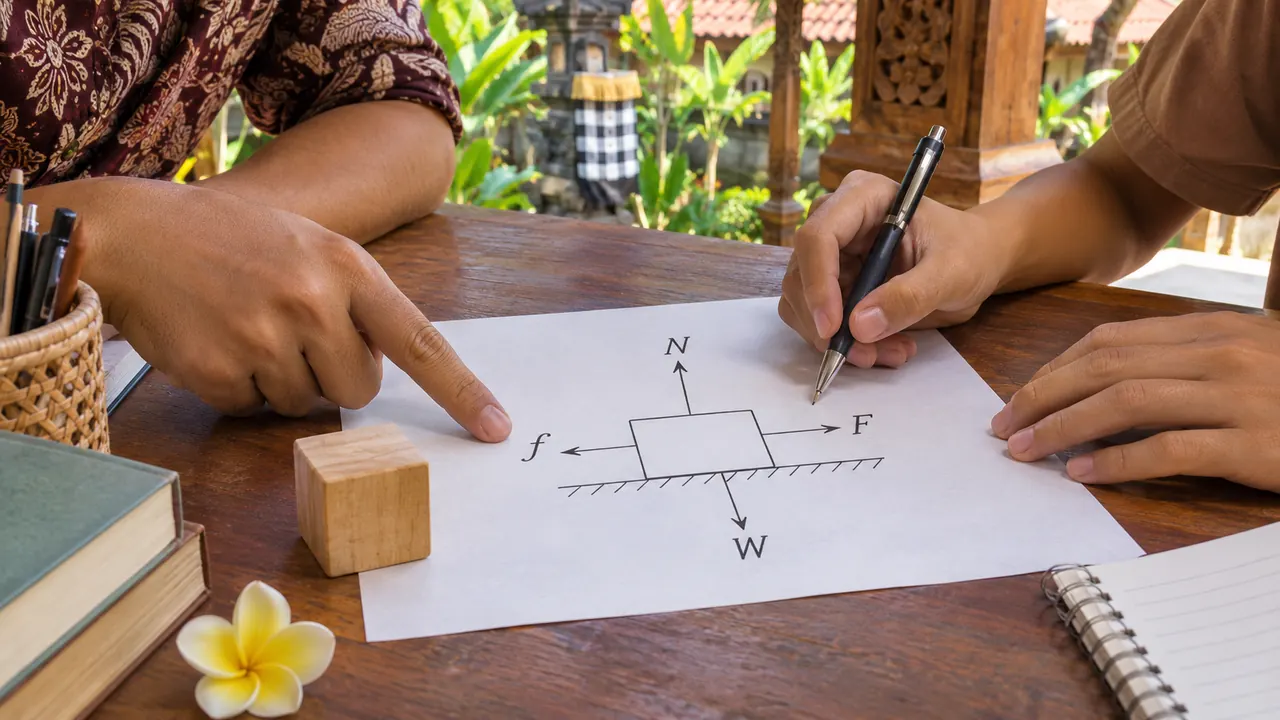
This AI-generated image illustrates force-diagram checking with fictional people; it is not an actual tutoring session.
Ask four questions: Is every arrow attached to the chosen object? Can I name the interacting agent? Is the direction physically sensible? Have I included a motion arrow by mistake? Then compare the arrows with the object’s acceleration.
Balanced forces mean the resultant force is zero. That can describe an object at rest or moving at constant velocity. An object does not need a forward resultant force simply because it is moving forward.
Use the diagram before calculating
Choose axes that match the situation, especially on a slope. Resolve forces into components only after the original forces are clear. Write a resultant-force equation for each chosen direction and keep signs consistent with the axes.
If the calculation gives an unexpected negative value, return to the diagram and sign convention. The negative sign may reveal that the actual direction is opposite to the one assumed; it does not automatically mean the algebra is wrong.
Try a book resting on a level table
Choose the book as the object. Draw its weight vertically down and the table’s normal contact force vertically up. If the book is at rest with no other vertical force, those two forces balance, so the arrows have equal lengths. If the question gives a weight of 4 N, the normal contact force is also 4 N, giving a vertical resultant of 4 N − 4 N = 0 N. No horizontal force is needed simply to keep it still.
The book also pushes down on the table. That force belongs on a diagram of the table, because it acts on the table. It is the interaction partner of the table’s force on the book; it is not a third force on the book. This distinction prevents a common confusion between balanced forces on one object and Newton’s third-law pairs on different objects.
Get help connecting diagrams and equations
If a learner can recall force names but struggles to decide which forces act or how to turn a diagram into an equation, bring the exact syllabus and a recent question to a physics tutoring discussion.
Families arranging sessions near the south-west coast can review the Legian tutoring area page. For the next algebraic step, see how to rearrange a physics equation.
Frequently asked questions
Should velocity be shown on a force diagram?
Usually no. Velocity and acceleration describe motion, while a force diagram shows interactions acting on one object. Use a separate motion arrow if the question needs it.
Can an object moving at constant speed have balanced forces?
Yes. If its velocity is constant, acceleration and resultant force are zero. Individual forces may still act, but their vector sum is zero.
Related
Message us on WhatsApp: +62 858 6969 6869 · info@privatetutoringbali.com · We reply within one working day.