Maths problem solving
How to check a multi-step maths answer
A second calculation is useful only when it tests the first one. Estimate the likely size, use an inverse or substitute the result, then trace any disagreement to one step.
Published

Predict the size before checking the details
Start with a rough estimate. Round the important numbers enough to decide whether the final answer should be tens, hundreds or thousands, and whether it should be positive, negative, greater than one or less than one. An estimate is a boundary for the answer, not a replacement for the exact work.
For example, 398 + 267 is close to 400 + 300, so an answer near 700 is plausible. An exact answer of 6,650 is not. This first check can expose a misplaced decimal, copied digit or incorrect operation before a learner repeats every line.
The opening photograph is an AI-generated illustration with fictional Indonesian people. It does not show a real lesson, tutor, learner, classroom or school partnership.
Choose a check that is genuinely different
Repeating the same keystrokes can reproduce the same mistake. Use a different route. Addition can be checked by subtraction, multiplication by division and a solved equation by substituting the value into the original equation.
When a problem has several stages, check the final operation first. If that stage is correct, move backwards to the previous line. This is usually faster than restarting and makes the location of the error visible.
| Original work | Independent check | Question to ask |
|---|---|---|
| Addition or subtraction | Use the inverse operation | Does the check recover the starting value? |
| Multiplication or division | Use the inverse or a rough product | Is the size and place value sensible? |
| Solve an equation | Substitute into the original equation | Do both sides have the same value? |
| Formula problem | Check units and substitute the result | Does the result satisfy the relationship? |
Separate method errors from arithmetic errors
If the check fails, do not label the whole solution wrong. Mark the first line where the new value no longer follows from the previous one. A method error means the mathematical plan or operation is unsuitable. An arithmetic error means the plan is sound but a calculation within it is inaccurate.
For a two-step example, solve 3x + 7 = 25. Subtracting 7 gives 3x = 18, then dividing by 3 gives x = 6. Substitute into the original equation: 3 × 6 + 7 = 25. If a learner instead writes x = 18, substitution gives 61, locating the missing division rather than asking them to repeat the whole problem.
This distinction determines the next action. A method error needs a new representation, example or explanation. An arithmetic error needs a precise correction and perhaps practice with the underlying fact or written procedure.
Use a compact four-part routine
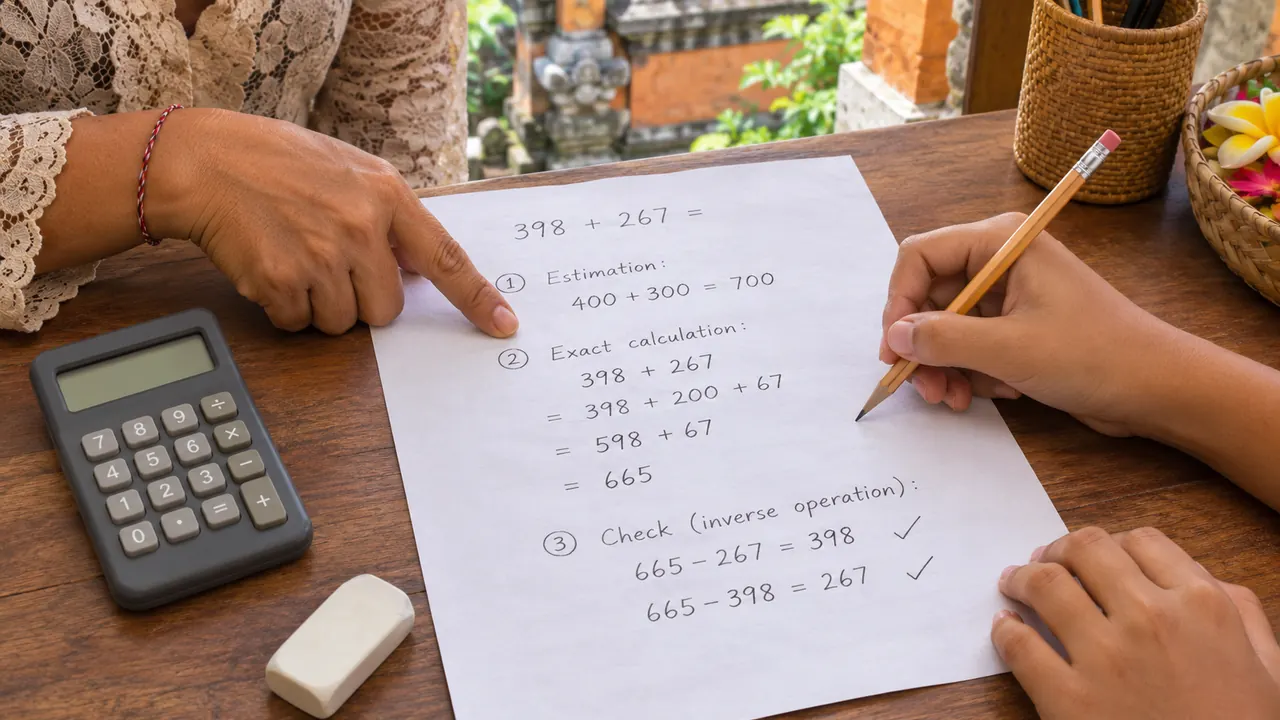
This AI-generated image illustrates a checking routine with fictional people; it is not an actual tutoring session.
Write four prompts beside the work: estimate, inverse, substitute and units. Not every question uses all four. The learner chooses the checks that match the structure of the problem, records enough evidence to make the check readable and corrects only the line that caused the disagreement.
After correcting it, run the independent check once more. The purpose is to confirm the repaired chain, not to create a third unconnected answer.
Practise checking without slowing every answer
During practice, check one representative problem from a set in full and use a quick estimate on the others. Before an assessment, agree which warning signs trigger a deeper check: an unexpected sign, an impossible measurement, a probability above one or an answer far from the estimate.
As the routine becomes familiar, the learner should be able to name the check before performing it. That small pause builds judgement about mathematical structure rather than dependence on an adult saying whether the answer is correct.
Get help with mathematical reasoning
If a learner can complete procedures but cannot yet explain or verify a chain of reasoning, bring a recent worksheet and the relevant course requirements to a maths tutoring discussion.
Families looking for face-to-face support in east Bali can review the Amed tutoring area page. For a related exam skill, see how to show working clearly in IGCSE Maths.
Frequently asked questions
Is using a calculator enough to check a maths answer?
A calculator can check arithmetic, but it does not confirm that the correct operation, formula or interpretation was used. Combine it with an estimate or substitution.
What should a learner do when two answers disagree?
Return to the first line where the values stop following logically. Decide whether the issue is the chosen method or one calculation, then repair and recheck that line.
Related
Message us on WhatsApp: +62 858 6969 6869 · info@privatetutoringbali.com · We reply within one working day.