Sixth-form mathematics habits
Should your calculator be in degrees or radians?
Match the calculator mode to the angle unit in the question. Changing the mode changes how a number is interpreted; it does not automatically convert the number you have typed.

A sensible method can still produce the wrong display
Suppose a student enters sin 30 expecting 0.5, but sees a negative decimal near -0.988. Before rewriting the trigonometry, check the angle mode. The calculator may be interpreting 30 as radians rather than 30 degrees. The device has evaluated a different angle; the unexpected answer is a clue, not proof that the whole method is wrong.
This matters as students move into sixth-form work, where radians appear regularly alongside degrees. Cambridge International AS & A Level Mathematics 9709 for 2026 and 2027 includes circular measure and trigonometric work in both units. It does not follow that every question at that level uses radians. Read the unit each time.
The fictional educator and learner in the hero are AI-generated illustrations. The circular object introduces angle measurement; it is not a scale diagram, a real lesson or evidence of a school partnership.
Two quick tests can confirm the mode
In degree mode, sin 30 should return 0.5. In radian mode, sin(π/6) should return 0.5. Use the calculator’s π key rather than replacing π with a short decimal. These are checks you can perform before a practice set; they are not a reason to guess the unit from whichever result looks convenient.
Find the angle setting in the manual for your exact model. Depending on the calculator, the display may use DEG or RAD, or a shorter indicator. Menu sequences differ, so a sequence remembered from another model may not work. Changing a display setting such as fixed decimal places is not the same as changing the angle unit.
After resetting the device or borrowing a different calculator, check again. A useful habit is to write the required unit beside the first trigonometric expression on your working page. That visible reminder is easier to revisit than a setting changed silently at the beginning of the week.
Convert the angle, not just the setting
A straight angle is 180 degrees or π radians. To convert degrees to radians, multiply by π/180; to convert radians to degrees, multiply by 180/π. The angle stays the same while its numerical measure changes. Sixty degrees is π/3 radians, not 60 radians.
If a calculation contains 60° and you choose to work in radians, replace the angle with π/3 as well as selecting radian mode. Merely changing the setting while leaving the entry as 60 asks the calculator a different question. Converting twice is another trap: once the expression is in radians, do not multiply by π/180 again.
| Degrees | Equivalent radians | Useful check |
|---|---|---|
| 30° | π/6 | sin is 0.5 |
| 60° | π/3 | cos is 0.5 |
| 90° | π/2 | A right angle |
| 180° | π | A straight angle |
Arc length shows why the unit changes the formula
For a circle of radius 8 cm and an angle of 60°, the arc length can be calculated as 60/360 of the circumference: (60/360) × 2π × 8 = 8π/3 cm. Using radians, the same angle is π/3, so the formula s = rθ gives 8 × π/3 = 8π/3 cm. The two methods agree because the angle was expressed consistently.
Putting 60 directly into s = rθ gives 480 cm, which is not the arc for a 60° sector of this circle. That compact formula requires θ in radians. A calculator cannot fix a unit mistake in a formula containing only multiplication; DEG or RAD affects trigonometric interpretation, not the meaning of every number in your working.
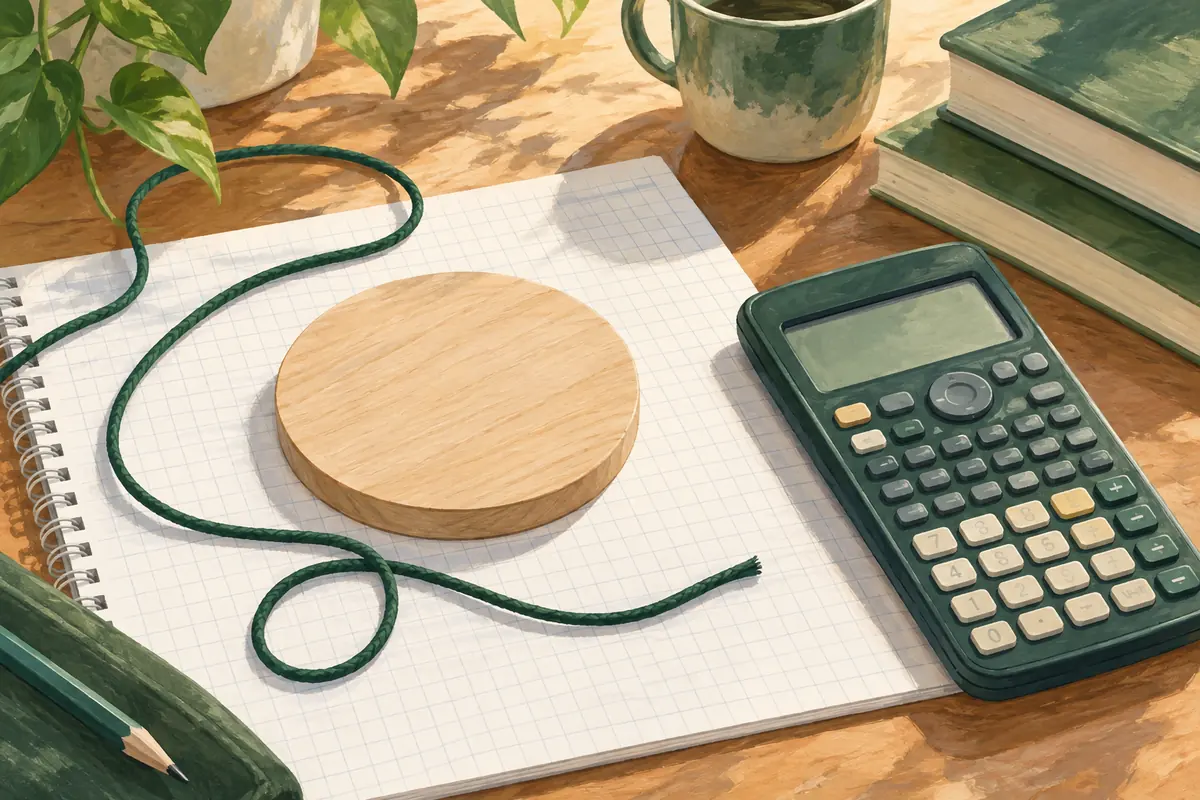
Generated still life for discussing circular measure. The disc and cord are illustrative materials, not an accurately measured construction; use the written example for the calculation.
Check inverse functions and solution intervals too
For an inverse sine calculation, the output angle also follows the selected unit. The inverse sine of 0.5 gives 30 in degree mode and π/6, approximately 0.5236, in radian mode. Label the result so that a correct number does not become an ambiguous answer.
An inverse-function output is not always the complete solution to a trigonometric equation. Over 0° to 360°, sin x = 0.5 has solutions 30° and 150°. Over 0 to 2π radians, the corresponding solutions are π/6 and 5π/6. Read the interval, use the relevant graph or symmetry and check every solution; switching calculator mode does not find the missing branch.
When a marked answer is wrong, classify the issue before choosing practice: incorrect mode, failed conversion, wrong formula unit or missing solution. Our guide to reviewing mock-exam mistakes helps keep these different problems separate.
Prepare a useful question for the next lesson
Bring the original task, calculator model, selected mode and your written steps when discussing sixth-form subject support. A screenshot of the final display alone may hide where the interpretation changed. The IGCSE-to-A-Level transition guide addresses the broader course step; this guide is only about angle units and calculator checks.
For families fitting lessons around a home in Tabanan, the Tabanan practical arrangements help frame the delivery discussion. Share the exact location and timetable rather than assuming in-person availability. If the student is following a different qualification, include its name so that examples and notation can match the actual course.
Frequently asked questions
Should an A-Level calculator always stay in radian mode?
The setting should follow the question. Sixth-form work can use either degrees or radians. Check the units and interval, and remember that s = rθ uses radians even though the calculation may contain no trigonometric key.
Does a number written with π always represent an angle?
π can appear in lengths, areas and other expressions as well as angles. Read what the quantity represents. In a trigonometric argument, π/3 commonly denotes radians, but a standalone expression needs its surrounding context and units.
Related
Message us on WhatsApp: +62 858 6969 6869 · info@privatetutoringbali.com · We reply within one working day.
Sources and further reading
Published by Private Tutoring Bali. Sources and corrections.