Reading comprehension
How to answer reading comprehension with text evidence
A strong response gives an answer, points to precise evidence and explains the connection instead of copying a whole paragraph.
Published

Work out what kind of understanding the question tests
Before searching the passage, underline the action in the question. A literal question asks for information stated directly. An inference question asks the reader to combine a clue with what they know. An evaluative question asks for a judgement that still needs support from the text.
A learner who treats every question as “find matching words” may copy a sentence without answering. Restate the question as a simple task: find a fact, infer an idea, explain a choice or judge an effect. That decision narrows where to look and how much explanation is needed.
The opening image is an AI-generated reading scenario with fictional Indonesian people; it is not evidence of staff, pupils or a school affiliation.
Answer first, then collect the smallest useful evidence
Write a short answer in the learner’s own words before adding a quotation. For the question “Why is Mara reluctant to enter the room?”, an answer might begin, “Mara expects the meeting to be uncomfortable.” The evidence should then be the brief phrase or detail that supports that idea.
Copying four lines can hide whether the learner knows which clue matters. Select the smallest complete phrase that carries the evidence. If the question allows paraphrase, state the detail accurately without changing its meaning. Keep names, pronouns and time references clear.
| Part | Purpose | Example shape |
|---|---|---|
| Answer | Respond directly to the question | Mara expects an uncomfortable meeting. |
| Evidence | Point to the relevant clue | The passage says she pauses outside and rehearses an excuse. |
| Explanation | Connect clue to answer | These actions suggest avoidance rather than simple lateness. |
Explain the link instead of repeating the quotation
The explanation should name what the evidence shows. Avoid writing, “This shows she is uncomfortable because she is uncomfortable.” Ask what the action, word choice or contrast lets the reader conclude. The useful sentence often begins with “This suggests…” followed by a reason.
For an inference, separate clue from background knowledge. If a character checks the clock three times and keeps looking at the door, the text gives two actions. The reader’s conclusion may be that the character is anxious for someone to arrive. That conclusion is supported, but it is not stated word for word.
Use a three-box note before writing the full response
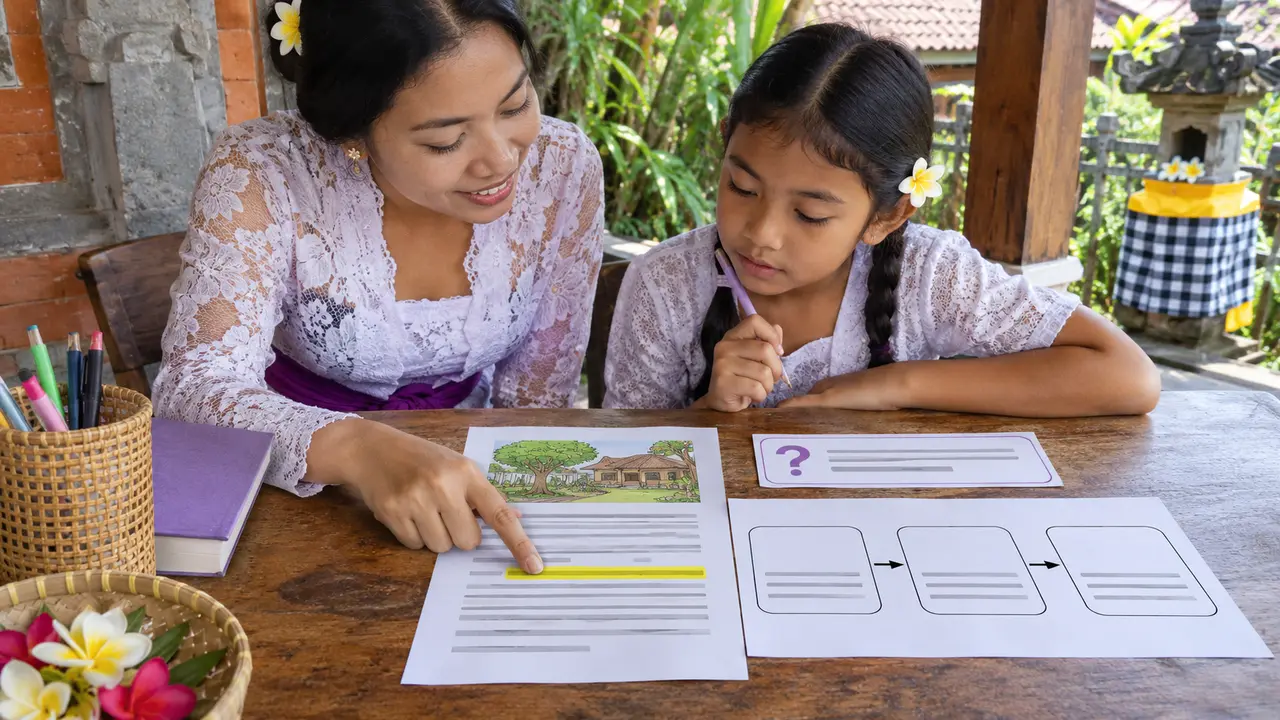
This AI-generated planner scene uses fictional people to demonstrate the three-box method; it does not document a tutoring session.
Divide scrap paper into answer, evidence and explanation. Fill each box with notes rather than full sentences. This reduces the temptation to start copying and makes a missing step visible before the final answer is written.
For a longer response, repeat evidence and explanation only when a second point is genuinely different. Two quotations that prove the same thing do not automatically add depth. Choose a new aspect, such as a change in behaviour, a contrast or a pattern in language.
Check the response against the wording of the question
Circle the key noun in the question and find it, or a clear equivalent, in the answer. If the question asks how the mood changes, a response that only describes the final mood is incomplete. If it asks for two details, number the two choices before writing.
Then test the evidence: could it support a different answer just as easily? If so, the evidence may be too general. Finally, remove copied material that is not used in the explanation. Precision is more helpful than length.
Get help with comprehension, not answer production
If a learner reads fluently but struggles to select evidence or explain an inference, bring one passage and the learner’s own attempt to a reading tutoring discussion. A tutor should teach the process and preserve the student’s authorship rather than supply school answers.
Families planning in-person support in North Bali can check the Lovina tutoring area page. For a related nonfiction skill, use the guide to summarising without copying.
Frequently asked questions
How much text evidence should a child quote?
Use the shortest phrase or detail that clearly supports the answer. The amount depends on the task, but copying a whole paragraph usually makes the reasoning less clear.
What is the difference between evidence and explanation?
Evidence comes from the text. Explanation states how that evidence supports the answer or inference.
Related
Message us on WhatsApp: +62 858 6969 6869 · info@privatetutoringbali.com · We reply within one working day.