Reading for the main idea
How to help your child summarise nonfiction without copying
Find what the passage is mainly saying, select the details needed to explain it, then put the text aside briefly and tell the idea in your own words. Reopen the passage to check accuracy.

A shorter passage is not necessarily a summary
Copying the first sentence of each paragraph makes a text shorter, but may leave its meaning behind. A useful summary selects the main ideas and the essential connections between them. It does not try to preserve every example, and it does not add the reader's own explanation of what probably happened.
ReadWriteThink's summarising guidance centres on selecting important information. Its GIST lesson uses a short word limit to practise that selection, but a school assignment may require a different length. Start with the task: are we summarising the whole passage, explaining one section, or answering a particular question?
The hero is an AI-generated illustration of fictional people, not a photograph of our educators, pupils or a partner school. The passage below was written for this guide; it describes an invented situation, not a real school initiative.
Try a passage with a problem, response and result
Read this practice information text together: At Meadow Library, returned books sometimes waited in a mixed pile until Friday. Readers could not borrow those books while they were waiting to be sorted. The librarian introduced three labelled return trays: stories, information books and picture books. Volunteers checked the trays every afternoon and put the books back on their shelves. After the change, returned books were usually available the next day. The trays were green and stood beside the entrance. Volunteers still referred damaged books to the librarian rather than shelving them.
Ask your child what changed and why it mattered. The core is not that a library bought green trays. The passage explains how a new sorting and checking routine made returned books available sooner. The colour and position help us picture the scene, but neither is needed to explain that improvement.
If a word such as returned or shelving is unfamiliar, explain it before asking for a summary. A child cannot choose the most important idea reliably while guessing the meaning of the sentences. You can read the passage aloud if the immediate aim is comprehension rather than independent word reading.
Compare three possible answers
| Attempt | What it does | What to check |
|---|---|---|
| The library has green trays by its entrance. | Selects a true detail. | Misses the problem, the changed routine and its result. |
| Volunteers sorted books, so everyone read more. | Connects an action with a claimed result. | The passage does not say that people read more. |
| The library made returned books available sooner by sorting them into labelled trays and checking them daily. | Combines the change with its stated result. | Preserves the main explanation without copying a whole sentence. |
Notice that the stronger answer keeps ordinary words such as library and books. Writing in your own words does not mean replacing every noun with an awkward synonym. It means choosing and organising the important ideas yourself, while keeping names and necessary subject terms accurate.
The damaged-book rule is real information within our invented passage. It could matter in a summary of the return procedure, but is less central to a brief explanation of how waiting time changed. What belongs in a summary depends on its purpose, not just on whether a sentence is interesting.
Use notes as a bridge, not a second copy
Try three small notes: books waiting; labelled trays plus daily checks; available sooner. Ask your child to explain how those notes connect while the passage is covered. Then uncover it and check whether the spoken explanation is accurate. Covering the text is a brief practice aid, not a rule that a child must remember everything without looking back.
For another passage, the useful notes might instead be a comparison, a sequence or a cause and effect. Do not force every information text into a story outline. A paragraph comparing two materials may need both similarities and differences; a process explanation needs the important stages in the right order.
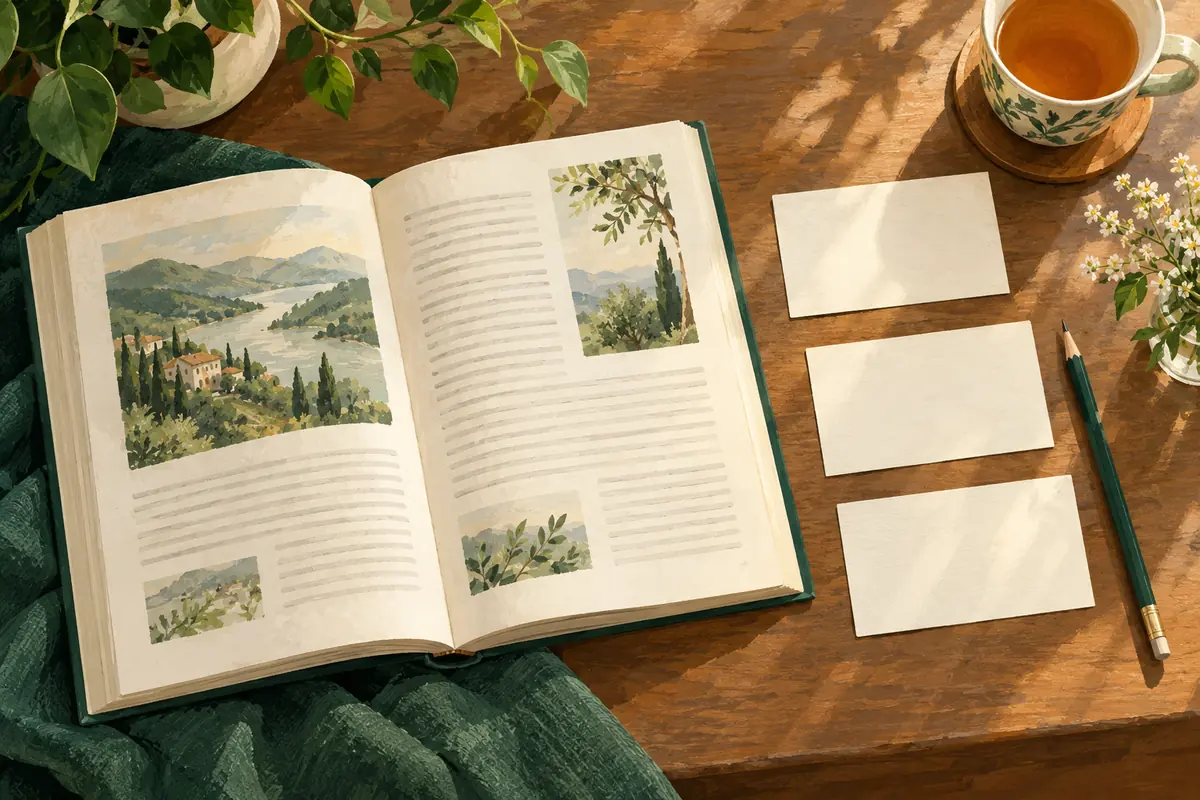
AI-generated still life illustrating the idea of short notes. The cards are deliberately blank; use your child's own notes rather than treating the picture as a model answer.
Check meaning before polishing the wording
Ask three questions: does the summary cover the main point, is every claim supported, and is anything included only because it was easy to copy? Compare the answer with the source, not with the adult's preferred sentence. Two well-written summaries can organise the same essential information differently.
Keep summaries separate from interpretations. If the task asks what a character may be feeling, our reading inference examples address that different skill. Here, saying the librarian was frustrated would add a feeling that the passage never states. Likewise, revising a child's own composition is a writing task, not a summary of someone else's text.
For school research, keep the source title and author or organisation with the notes, and follow the teacher's citation instructions. Changing the wording does not make the original ideas your own. A summary should not become a way to hide where information came from.
Choose the next step from the difficulty you hear
If your child lists every detail, practise selecting just the information needed for one question. If the main idea is clear orally but the written answer becomes copied, let the child rehearse a sentence before writing. If meaning is unclear even in discussion, use the broader fluency and comprehension guide to frame a conversation with the teacher.
For repeated difficulty choosing and explaining key ideas, explore individual reading support. Bring the source passage, the assignment and an uncorrected attempt, noting any help given. Families staying in Legian can use the Legian lesson arrangements page when discussing a suitable location and schedule; availability and exact-address arrangements need confirmation.
Frequently asked questions
How many sentences should a nonfiction summary have?
Follow the assignment and the amount of information that needs to be represented. One sentence can work for a short practice passage; a longer text may need more. Check meaning and accuracy before trying to meet a word limit.
Can a summary use words from the original text?
Names and necessary subject terms can stay. The aim is to select and express the ideas independently, not replace every word. Use quotation marks for exact quoted wording and follow the school's instructions for acknowledging the source.
Related
Message us on WhatsApp: +62 858 6969 6869 · info@privatetutoringbali.com · We reply within one working day.
Sources and further reading
Published by Private Tutoring Bali. Sources and corrections.