Speaking with purpose
How to rehearse a school presentation without memorising it
Memorising a script can make one forgotten sentence feel catastrophic. Help the learner remember the route through the ideas instead: opening, evidence and conclusion, supported by compact cues and short audience-focused rehearsals.

Begin with audience and purpose, not slides
Ask two questions before writing: who will listen, and what should they understand, feel or decide by the end? A science explanation for classmates, a persuasive speech for teachers and a personal reflection for parents require different vocabulary and evidence.
Write the central message in one sentence, then test whether every example earns its place. The Australian Curriculum treats speaking as communication shaped for audience, purpose and task. That is a more useful starting point than designing slides first and trying to narrate them afterwards.
The rehearsal scene is an AI-generated editorial illustration. Its learner, adult and home are fictional and do not depict a client, tutor, school or promised outcome.
Build a route through three meaningful parts
Use a simple structure: orient the audience, develop the important idea with evidence, then close by returning to the purpose. Each part can contain more than one point, but the learner should be able to explain why it is there.
Ask the child to retell the route conversationally before polishing sentences. If they cannot move from one idea to the next without reading, the structure may still be unclear. Rearrange the ideas until the sequence makes sense when spoken aloud.
| Presentation part | Question it answers | Useful cue |
|---|---|---|
| Opening | Why should this audience listen? | One image or key phrase |
| Development | What evidence or example makes the idea clear? | A number, object or contrast |
| Connection | How does the next point follow? | A short transition phrase |
| Closing | What should the audience remember? | Return to the central message |
Make cue cards smaller than the temptation to read
Put one prompt on each card: a picture, a key term, a number or a question. Full sentences invite reading and turn eye contact into a memory test. The card should help the learner recover the next idea while leaving them free to speak naturally.
Practise looking at the cue, looking up and explaining. If a technical definition must be exact, mark that single sentence as a deliberate quotation or precise statement rather than turning the whole presentation into a script.
Rehearse in rounds with a different focus each time
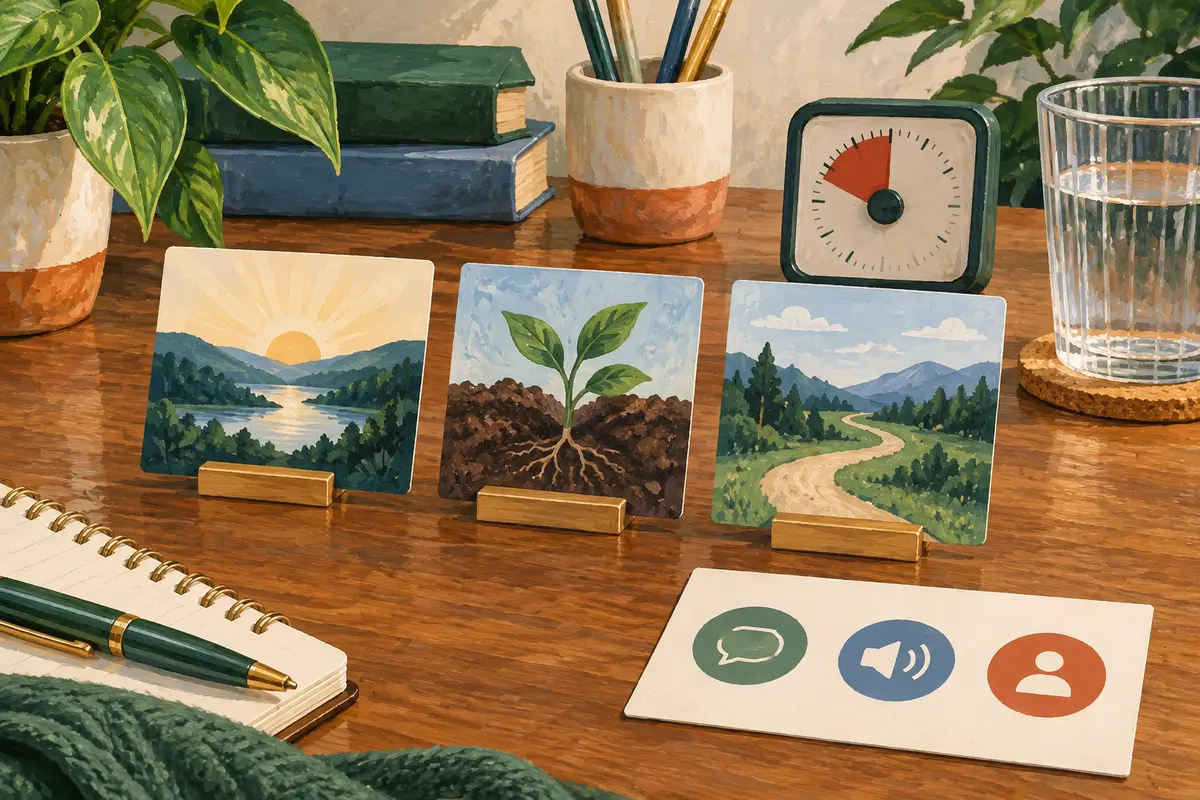
The generated still life illustrates a rehearsal system. Its images and feedback symbols are fictional and contain no school assessment criteria.
First rehearse only the sequence, stopping whenever the route becomes unclear. Next rehearse audibility and pace. Then add one listener and ask for feedback on one criterion, such as whether the example made sense. Timing comes after the content is stable; otherwise the child may simply speak faster to fit.
Introduce small variations so recall is flexible. Change the listener’s chair, ask one predictable question or begin after a short pause. The goal is not to make practice stressful. It is to prove that the presentation still works when the exact wording changes.
Respond to a forgotten line without restarting
Teach a recovery routine: pause, breathe, check the cue and restate the last secure idea. Rehearse the recovery on purpose once or twice. A learner who knows how to continue does not need perfect recall to feel prepared.
Give feedback that can guide the next attempt. “Be confident” is not an action. “Pause after the example so the audience can follow” or “lift the final sentence away from the card” is specific and observable. Keep praise equally precise.
Our confidence and communication tutoring can help a learner organise ideas, rehearse delivery and reflect on feedback without promising to remove normal nerves. Families staying around Kuta can review Kuta tutoring arrangements. The confidence after academic difficulty guide offers a broader approach to rebuilding participation.
Frequently asked questions
Should a child memorise the opening and ending?
A precise opening or final sentence can be rehearsed closely, but the learner should still know the idea route. That makes recovery possible if the exact wording disappears.
How many full rehearsals should a child do?
Use as many as produce useful improvement without flattening the delivery. Several short rounds with one focus each are often more informative than repeatedly performing the whole script.
Related
Message us on WhatsApp: +62 858 6969 6869 · info@privatetutoringbali.com · We reply within one working day.
Sources and further reading
Published by Private Tutoring Bali. Sources and corrections.