School partnership skills
How to prepare for an international school parent-teacher meeting
Review recent work, ask the learner what they notice, choose three focused questions and leave the meeting with one clear action and a review date.
Published

Start with the purpose of the meeting
A parent-teacher meeting is short, so decide what the family most needs to understand. The goal may be to clarify progress, interpret feedback, discuss a recurring barrier or agree how home and school can support the same next step.
Read the latest report, assignment feedback and school communication before the meeting. Note patterns rather than collecting every mark. A single low score may reflect one topic, format or difficult week.
The opening meeting photograph is AI-generated with fictional Indonesian people. It does not show a real tutor, learner, school or client meeting.
Include the learner’s perspective
Ask the learner what feels secure, what feels difficult and what help has been useful. Their explanation may reveal that the problem is task instructions, vocabulary, organisation, confidence or a missing concept.
For an older learner, agree which points they want to raise themselves. For a younger child, bring one example of work they are proud of and one that caused difficulty.
| Preparation area | Evidence to bring | Focused question |
|---|---|---|
| Progress | Recent report or assessed work | What change have you noticed across this term? |
| Current barrier | One representative task or pattern | What seems to be causing the difficulty in class? |
| Expectations | Rubric, criteria or teacher comment | What would successful next work look like? |
| Follow-up | Family and school availability | What should each person do before the review date? |
Choose three questions
Write the questions in priority order. One should clarify current evidence, one should explore the likely cause and one should establish the next action. Specific questions invite useful examples.
Avoid using the short meeting to compare the learner with classmates or to demand a predicted outcome. Ask what the teacher observes, which criteria apply and how progress will be checked.
Clarify language, criteria and timelines
International programmes may use subject criteria, stages, bands, command terms or school-specific reporting language. Ask the teacher to show how the wording connects to one piece of the learner’s work.
If a deadline, assessment format or support process is unclear, confirm it before the meeting ends. Repeat the agreed action in your own words so misunderstandings can be corrected immediately.
Leave with one shared next step
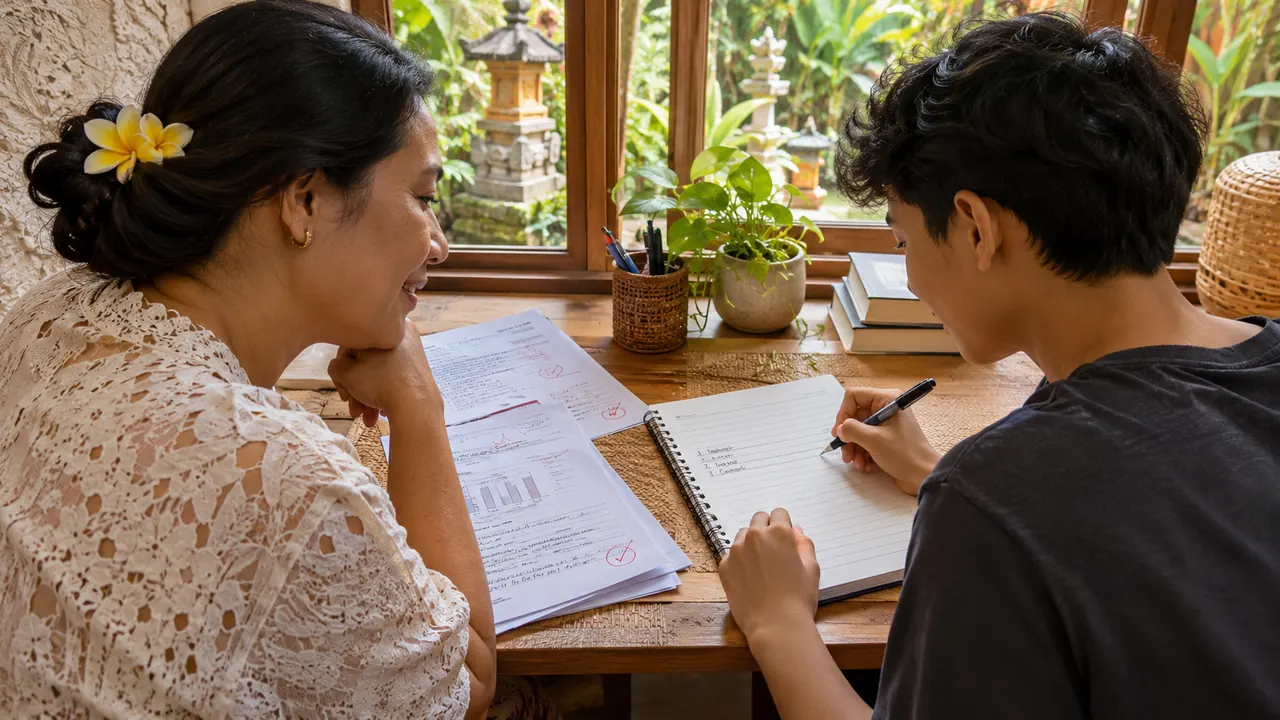
This meeting-preparation image is AI-generated with fictional people and does not document an actual school conference.
Record one action for the learner, one for home and one for school only if each is necessary. Give the plan a realistic review date and decide what evidence will show whether it helped.
After the meeting, explain the plan to the learner without turning the conversation into a verdict. A useful follow-up is concrete, limited and connected to the teacher’s actual expectations.
Get help interpreting school feedback
If reports, criteria or several subject concerns are difficult to connect, bring the school’s feedback and recent work to an international school tutoring discussion. The commercial school-support page owns service enquiries; this guide focuses on meeting preparation.
Families in Denpasar can also review the Denpasar tutoring area page. The school-report planning guide shows how to convert one recurring comment into a measurable learning goal.
Frequently asked questions
Should a child attend a parent-teacher meeting?
That depends on the school, age and meeting purpose. Where appropriate, agree in advance which points the learner can contribute and follow the school’s meeting format.
What should parents bring to the meeting?
Bring a small set of relevant evidence: the latest report, one representative task, the learner’s perspective and three prioritised questions.
Related
Message us on WhatsApp: +62 858 6969 6869 · info@privatetutoringbali.com · We reply within one working day.