Spelling strategy
How to map a spelling word before trying to memorise it
Do not begin with ten visual copies. Say the word naturally, identify its sound sequence, connect those sounds to letters, mark the unexpected part and then retrieve the word after it is covered.

Find out what the child is currently representing
Ask the child to spell the word without first showing the answer. Read their attempt as evidence. Which sounds have they noticed? Which sound is missing? Have they represented a sound with a plausible but incorrect letter pattern? An attempt such as sed for said is not random; it shows that the child heard the sounds but does not yet know the unusual spelling choice.
This distinction matters. Copying may produce a correct line while leaving the child unable to retrieve the word later. Mapping starts with spoken language and makes the relationship between sounds and written symbols explicit.
The opening artwork was generated for this guide. Its learner, educator and materials are fictional; they do not represent a diagnosis, assessment or real tutoring session.
Use a six-step mapping routine for one word
First, say the word in a normal sentence so its meaning is clear. Second, repeat it slowly without stretching it into different sounds. Third, move one blank counter for each phoneme, or smallest sound unit. Fourth, replace the counters with the letters or letter groups that represent those sounds. Fifth, identify the part that is expected and the part that must be remembered. Finally, cover the model and write the whole word from memory.
The number of sounds is not always the number of letters. A pair of letters may represent one sound, and the same sound can have several spellings. The Department for Education reading framework describes this relationship as grapheme-phoneme correspondence. For spelling, the learner works in the reverse direction: from the sounds they can say to an appropriate written representation.
| Step | Adult prompt | Evidence to notice |
|---|---|---|
| Meaning | Use the word in a sentence | The intended word is clear |
| Sounds | Say it; move one counter per sound | No sound is omitted or added |
| Letters | Which letters could represent each sound? | Known correspondences are applied |
| Tricky part | Which part is not what you expected? | Attention is focused, not spread across the word |
| Retrieval | Cover it and write it | The learner recalls rather than copies |
Treat plausible spellings as a starting point
English spelling contains both regular patterns and exceptions. If a child writes a plausible spelling, acknowledge the logic before teaching the conventional form. Saying “you heard every sound; this sound is written differently in this word” gives accurate feedback without pretending the attempt was correct.
Group words only when the relationship is useful. A small set that shares a meaningful spelling pattern can reveal structure. A long list that merely looks similar may overload the exact distinction the child needs to learn. Include pronunciation and vocabulary, because spelling an unknown word mechanically is fragile learning.
Move from supported mapping to independent retrieval
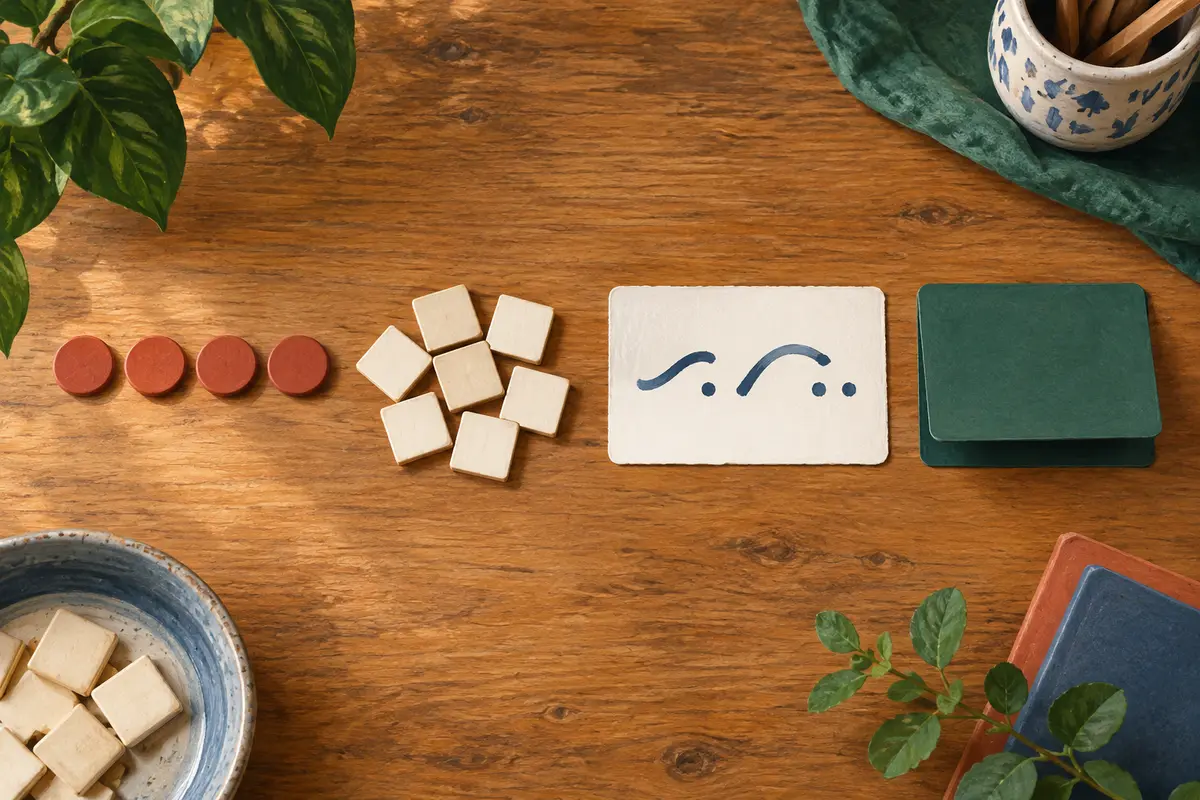
This generated diagram uses abstract marks rather than a real word. It illustrates the routine without presenting itself as a formal assessment.
After one mapped example, ask the learner to lead the steps on the next word. Remove the counters when they can segment accurately, but bring them back if sounds disappear. Delay the retrieval by a minute, later in the session and again on another day. Each attempt reveals whether the representation is becoming available without the model.
Use the word in a sentence after retrieval. This checks that spelling has not become detached from meaning. For older learners, repeat the same process with subject vocabulary and age-appropriate examples rather than returning to infant materials.
Know when practice is not enough
Persistent spelling and reading difficulty can have several explanations. A tutor can teach explicitly, record responses and coordinate with school, but cannot identify dyslexia. If difficulties are sustained and substantial, speak with the school learning-support team and a qualified specialist about assessment.
Our dyslexia tutoring support uses structured, cumulative teaching while maintaining that clinical boundary. Families near Legian can review Legian tutoring arrangements; the appropriate tutor and format still need confirmation. The phonics support explainer and reading fluency guide provide related context.
Frequently asked questions
Should my child copy each spelling word several times?
Copying may support handwriting, but it does not show that the word can be retrieved. Map the sounds and letter patterns, cover the model, then practise recall across more than one day.
Does difficulty with spelling prove dyslexia?
No. Persistent difficulty deserves careful teaching and, where appropriate, specialist assessment, but no single spelling pattern establishes a diagnosis.
Related
Message us on WhatsApp: +62 858 6969 6869 · info@privatetutoringbali.com · We reply within one working day.
Sources and further reading
Published by Private Tutoring Bali. Sources and corrections.