Research organisation
How should a student keep a research source log?
Give every source an ID, save enough detail to find it again and label copied words, paraphrases and original analysis before drafting.

A source log is the bridge between reading and writing
A bibliography made at the end cannot recover a page number that was never recorded or identify which sentence came from which browser tab. A working source log captures the trail while the material is still open. It supports accurate citation and helps the student see what evidence is missing.
The log is not the final bibliography. The school may require a particular citation style and additional fields. Use the log to preserve reliable raw information, then format the final references according to the teacher or school guidance.
The opening photograph is AI-generated. Its fictional Indonesian teacher and student are not our staff or a client, and the setting is not a partner school.
Give each source one stable ID
Label the first source S01, the second S02 and so on. Record the author or organisation, title, publication date when available, URL or book details, date accessed when required, and the exact page, section or timestamp used. Keep the ID beside every research note.
A saved URL alone is fragile. A useful locator lets the student reopen the source and find the same evidence. For a long webpage, record the section heading. For a PDF, record the printed page and, if different, the PDF viewer page.
Use separate fields for source material and thinking
| Field | What belongs there | Example label |
|---|---|---|
| Source ID and locator | Enough detail to find the passage again | S03, page 14 |
| Exact words | Copied wording inside quotation marks | QUOTE |
| Paraphrase | The source idea restated accurately in new wording | PARAPHRASE |
| Student analysis | Why the evidence matters to the research question | MY ANALYSIS |
| Next check | A claim, contrast or missing perspective to investigate | FOLLOW UP |
Paraphrased ideas still need a source
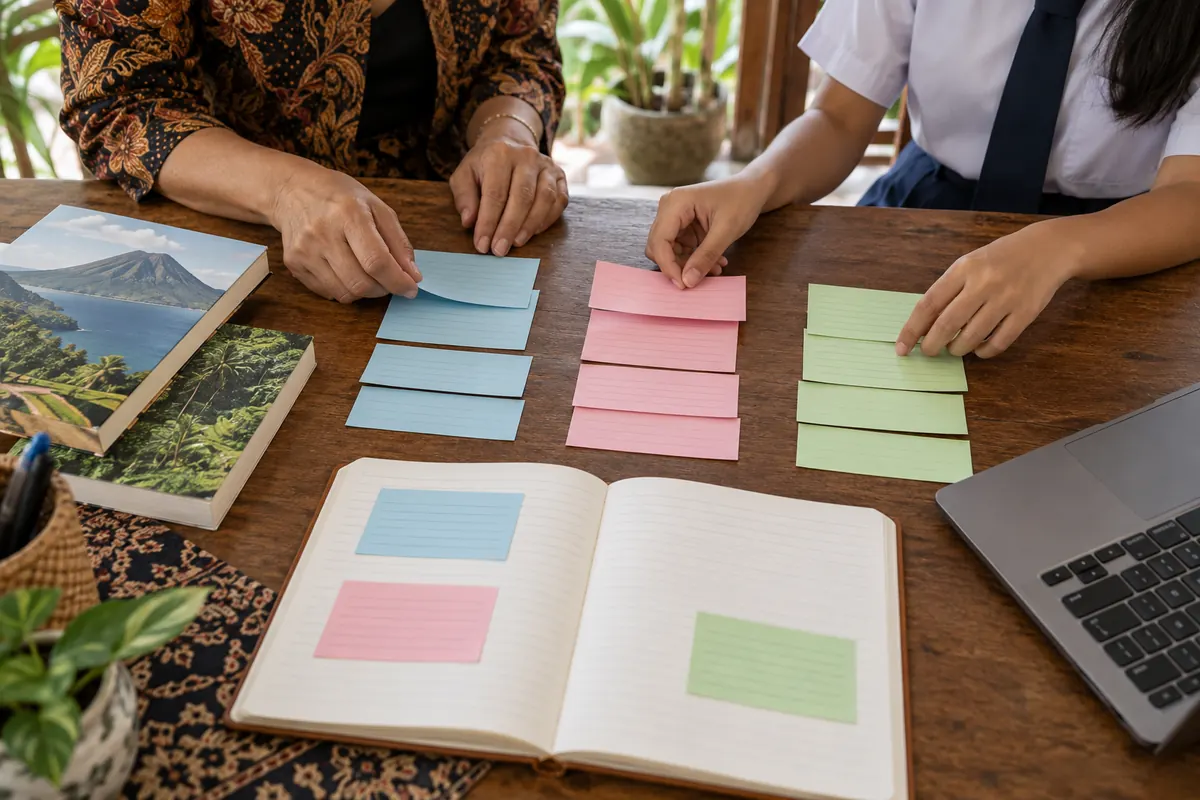
This generated photograph illustrates a note system. It does not show real research records, staff, clients or school materials.
Changing the wording does not turn another author’s idea into the student’s original idea. Keep the source ID beside a paraphrase and check it against the original for accuracy. Put unique wording copied from the source in quotation marks immediately rather than hoping to remember later.
International Baccalaureate academic integrity guidance expects sources to be acknowledged when material is quoted or paraphrased. The precise citation format should follow the school’s required style and the current instructions for the task.
Run a claim-to-source check before drafting
Write each planned claim on a separate line and add the IDs of the sources that support it. If a claim has no source, decide whether it is the student’s analysis that follows from cited evidence or an unsupported factual statement that needs research. If every claim relies on one source, look for another relevant perspective.
Do not use the log as a place to collect quotations without purpose. For every saved note, add one short sentence explaining how it may answer the research question, challenge another source or define a term.
Keep the student responsible for the research trail
A parent or tutor can model one row, ask where a claim came from and help the student interpret the school’s citation guide. The student should choose the sources, write the paraphrases and explain the analysis. Support must not become ghostwriting.
For broader programme support, the established IB tutoring page remains the commercial owner. Families planning in-person sessions near Denpasar can use the Denpasar tutoring page for area arrangements. The syllabus revision checklist guide shows a similar evidence-first approach for exam planning.
Frequently asked questions
Is a source log the same as a bibliography?
No. The log is a working research record with locators, notes and analysis. The final bibliography is formatted for submission using the citation style required by the school or task.
Do paraphrases need citations?
Yes. A paraphrase uses new wording but still communicates an idea from the source. Keep the source ID attached during drafting and cite it in the required style.
Related
Message us on WhatsApp: +62 858 6969 6869 · info@privatetutoringbali.com · We reply within one working day.
Sources and further reading
Published by Private Tutoring Bali. Sources and corrections.