Practical learning guide
Independent, dependent and control variables explained
Start with the question being tested. Identify what you deliberately change, what you measure and which other conditions need to stay consistent.

Why a list of definitions is not enough
A student may correctly recite three definitions and still choose the wrong variables in an investigation. The missing link is often the research question. Before naming anything, ask them to finish this sentence: 'I want to find out whether changing this affects that.' The two parts of that sentence give the experiment a direction.
The independent variable is the factor deliberately changed. The dependent variable is the outcome measured or observed. Control variables are other relevant conditions kept consistent so they do not offer a competing explanation. These roles belong to a particular question. The same quantity can play a different role in another investigation.
Science Buddies provides an accessible introduction to these distinctions and fair comparisons. The examples below are original teaching examples, not a laboratory protocol or an examination mark scheme. For assessed work, use the terminology and instructions provided by your child's school.
Build a question that can actually be measured
Consider an investigation into watering and seedling growth. 'Which plant is healthiest?' is difficult to answer consistently unless health is defined. A more precise question is: 'How does the daily volume of water affect the change in seedling height over a fixed period?' It names both the planned change and an observable outcome.
In that question, the amount of water is the independent variable. The change in height is the dependent variable. Record height from the same starting point, using the same unit and a consistent measurement method. A photograph can supplement observations, but a picture taken from a different angle is not a reliable substitute for a measurement.
Keep the plant type, starting stage, pot size, soil, light exposure and observation period as similar as reasonably possible. Living things naturally vary, so one plant in each condition is a weak basis for a broad conclusion. Discuss repeated specimens with the teacher and follow the school's safe practical instructions.
Use a planning table before collecting results
An experiment becomes easier to review when every variable includes a method. Writing 'water' in a list is vague. Writing 'daily water volume, measured in millilitres using the same measuring container' makes the intended change clearer. For the outcome, specify both what is recorded and when it is recorded.
Control variables need the same precision. 'Keep light the same' should prompt a discussion about how the plants are positioned. Do they all receive comparable light? Are some shaded by a wall? The purpose is not to pretend that a home setting is perfectly controlled, but to identify conditions that could affect the interpretation.
Make the results table before the investigation starts. Include the treatment, specimen label, initial measurement, later measurement and observation notes. Leave results blank until they are observed. Predicted numbers belong in a prediction discussion, not in a results column.
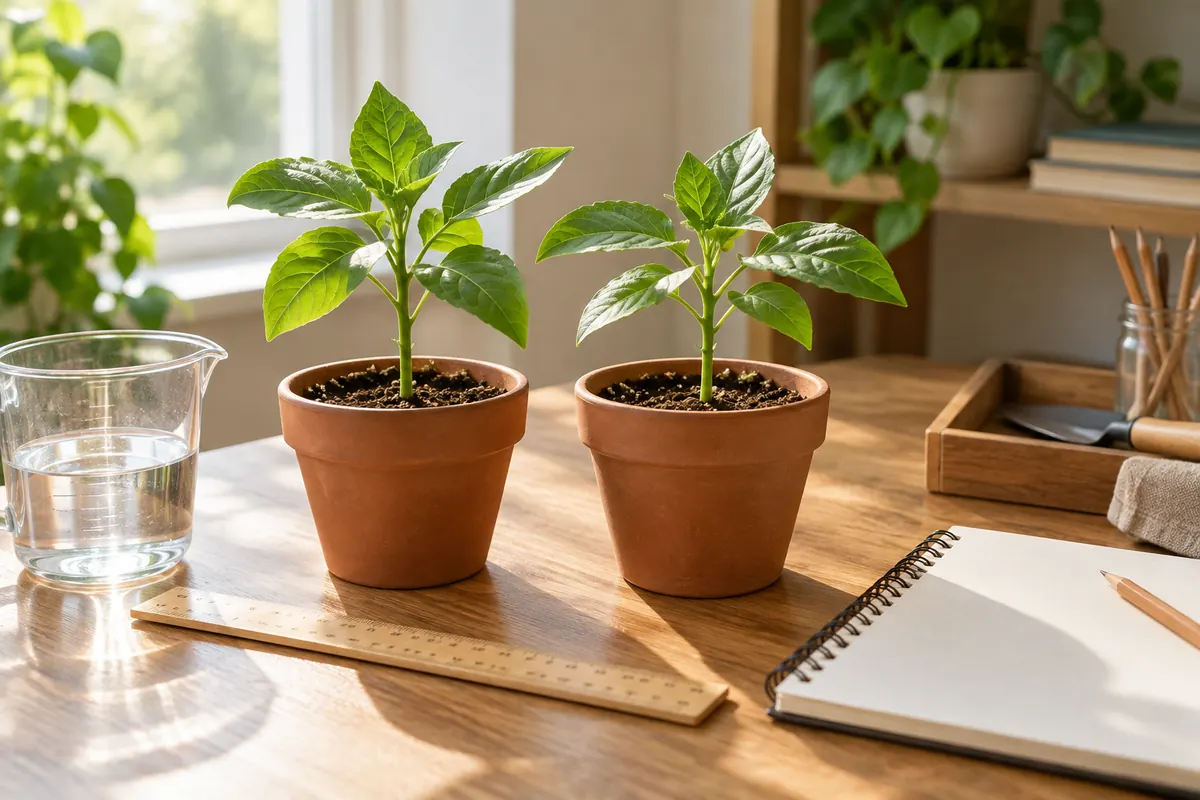
This generated still life illustrates observation materials. It does not document a real experiment or its results.
Separate control variables from a control group
These phrases sound similar but refer to different things. A control variable is a condition kept consistent. A control group or comparison condition provides a reference against which an intervention is assessed. Not every school investigation uses a separate untreated group, and the appropriate reference depends on the question.
For example, a project comparing two ordinary paper-fold designs may compare the designs directly. A student should not invent an unrelated 'control group' simply because the term appears in their notes. Ask what reference would make the result interpretable and check the assignment expectations.
Similarly, repeating measurements is not itself a control variable. Repeats help reveal variation and make unusual results easier to notice. They do not repair a design in which several relevant factors change together. Good planning and repeated observations solve different problems.
Write a conclusion that fits the evidence
Suppose a small investigation records a greater average height change in one watering condition. The conclusion should describe that observation within the tested conditions. It should not claim that the amount is best for every plant, season or soil. A measured difference, a proposed explanation and a universal rule are different kinds of statement.
A useful limitation identifies a specific problem and its possible effect. 'Human error' alone says very little. 'The ruler was read from different angles, so small height differences may be measurement error' is more informative. An improvement should address that problem directly.
When discussing uncertainty, resist the urge to rescue a preferred prediction. Unexpected observations are still observations. Students learn more by examining their method and evidence honestly than by rewriting the record to match a textbook expectation.
Bring the investigation, not just the mark
If practical-science questions remain difficult, bring the original task, variable table and teacher feedback to a support discussion. Those materials show whether the obstacle is question design, measurement, vocabulary or interpretation. Our science support page explains the service, while the IGCSE command-word guide helps distinguish describing a result from explaining it.
For a family based in Sanur, the area page is the practical next step for discussing home-session arrangements. Confirm the curriculum and current practical topic in the enquiry. A tutor can teach the reasoning and help a student evaluate a plan; the student must produce their own assessed work.
After further practice, try an unfamiliar investigation and ask the student to identify the variables without prompts. Explaining why each condition matters is a stronger sign of understanding than remembering the labels from a single example.
Frequently asked questions
Can time be an independent variable?
It can, depending on the research question and design. In another investigation, time may be the measured outcome or a fixed observation period. Decide its role from what is deliberately changed and what is measured.
Does keeping variables constant guarantee a fair experiment?
It improves the design, but measurement quality, natural variation and the way samples are selected also matter. Describe the conditions you controlled and the limitations that remain instead of claiming perfect certainty.
Related
Message us on WhatsApp: +62 858 6969 6869 · info@privatetutoringbali.com · We reply within one working day.
Sources and further reading
Published by Private Tutoring Bali. Sources and corrections.