IB assessment skills
IB command terms: describe, explain and evaluate
Read the command term as the job of the response, combine it with the subject content and mark allocation, and check that every paragraph performs that job.
Published

Treat the command term as an instruction
Knowing the topic is only part of an assessment response. The command term tells the learner how to use that knowledge. In an official IB glossary, describe asks for a detailed account, explain includes reasons or causes, and evaluate requires an appraisal that weighs strengths and limitations.
Always use the current subject guide, teacher instructions and question context. A general definition helps interpret the task, but it does not replace subject-specific criteria, the mark allocation or any required evidence.
The opening assessment photograph is AI-generated with fictional Indonesian people. It does not show a real tutor, learner, school or client session.
See how the same content changes
Imagine a question about a city’s public transport policy. A description could identify the policy’s main features. An explanation would connect those features to reasons or effects. An evaluation would judge the policy by balancing evidence about benefits, limitations and context.
The facts may overlap, but the response structure changes because the intellectual job changes.
| Command term | Response job | Useful self-check |
|---|---|---|
| Describe | Give a detailed account of relevant features | Have I stated what is present with enough specific detail? |
| Explain | Give a detailed account including reasons or causes | Have I made the because, how or why link explicit? |
| Evaluate | Appraise by weighing strengths and limitations | Have I used evidence to reach a supported judgment? |
Plan from the marks and subject criteria
Underline the command term, circle the content focus and note any limit such as one example, a named case or a time period. Check the number of marks and available time before choosing the depth of the plan.
For a longer response, write the judgment or central explanation in one sentence before drafting. List the evidence each paragraph will use. A plan should prevent irrelevant knowledge from filling space without answering the instruction.
Make the required thinking visible
For explain, use a clear chain: claim, reason or mechanism, evidence, and the consequence that returns to the question. For evaluate, state the criterion for judgment, examine both strengths and limitations, and show why one factor matters more in the stated context.
Avoid treating command terms as word-count labels. A long description can still fail to explain, and a list of advantages and disadvantages can still fail to evaluate if it never weighs them or reaches a reasoned judgment.
Audit one paragraph at a time
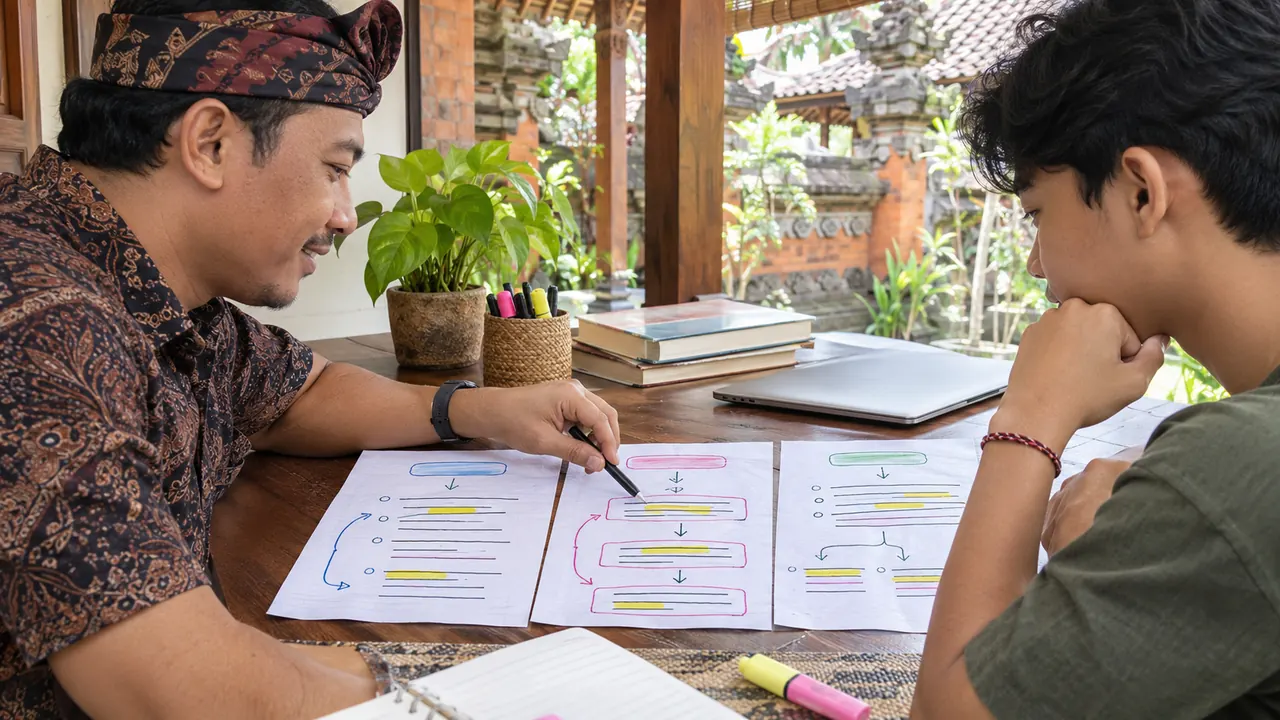
This assessment-planning image is AI-generated with fictional people and does not document an actual IB lesson.
After drafting, label the function of each sentence: content, reason, evidence, limitation, link or judgment. If the paragraph contains only content statements, it may not yet perform the command term.
Compare the answer with the subject criteria and teacher feedback. The aim is not to force every subject into one formula, but to make the required thinking visible in the form the subject expects.
Get help interpreting IB assessment tasks
If a learner understands the content but answers at the wrong level, bring the exact question, subject, level and current guide to an IB tutoring discussion. The commercial IB page owns programme and subject enquiries; this guide focuses on response decisions.
Families in Sanur can also review the Sanur tutoring area page. Use school-approved materials and current subject guidance when practising.
Frequently asked questions
Is explain the same as describe in IB questions?
No. Describe gives a detailed account, while explain also makes reasons or causes explicit.
Does evaluate always require a balanced answer?
Evaluation weighs strengths and limitations and reaches an evidence-based appraisal. The exact balance and structure depend on the subject guide, question and criteria.
Related
Message us on WhatsApp: +62 858 6969 6869 · info@privatetutoringbali.com · We reply within one working day.