Classroom independence
How to fade adult prompts in classroom support
Effective one-to-one support should make participation more possible without making an adult permanently necessary. Define the task, use the least intrusive prompt that works and plan the next smaller prompt before the learner becomes dependent on the current one.

Choose one observable act of independence
“Be more independent” is too broad to teach or measure. Choose one act within one classroom routine: open the correct page after the class instruction, begin the first question, ask a peer for a missing item, move to the next station or check finished work against a model.
Write what currently happens and what success would look like. The learner may already complete the task but only after three verbal reminders. The first goal is therefore not perfect unaided performance; it may be completing the same act after one visual cue.
The classroom above is an AI-generated editorial scene. Every person and detail is fictional, and the image does not imply a relationship with a school or a result from a real placement.
Arrange prompts from most to least support
A prompt ladder creates a shared language for adults. One possible order is: model the whole step, point to a visual cue, use a brief verbal cue, gesture, pause, then allow independent action. The right order changes with the task and learner. Safety instructions may require immediate direct language; a familiar worksheet may justify more waiting.
EEF guidance describes scaffolds as temporary supports that should be removed when they are no longer required. The practical implication is to decide how support will shrink at the moment it is introduced. Without that decision, a helpful prompt can quietly become the permanent starting signal.
| Prompt level | Example | Plan for reducing it |
|---|---|---|
| Model | Adult demonstrates the first step | Next attempt uses the finished example only |
| Visual cue | Point to a two-step card | Move the card farther away or remove one cue |
| Brief verbal cue | “Check the first step” | Replace the words with a gesture |
| Gesture | Point to the materials | Increase wait time before gesturing |
| Pause | Adult waits within agreed limits | Learner begins without an external cue |
Use wait time as an active teaching decision
Adults often prompt again because waiting feels like doing nothing. Set a reasonable pause and observe. Is the learner looking at the model, organising materials or recalling the routine? Processing can be productive even when it is not immediate.
Do not turn waiting into a silent test. If the learner shows confusion or distress, return to the smallest prompt that restores access. Independence grows from successful participation with less support, not from withholding help until a task fails.
Record the prompt, not just task completion
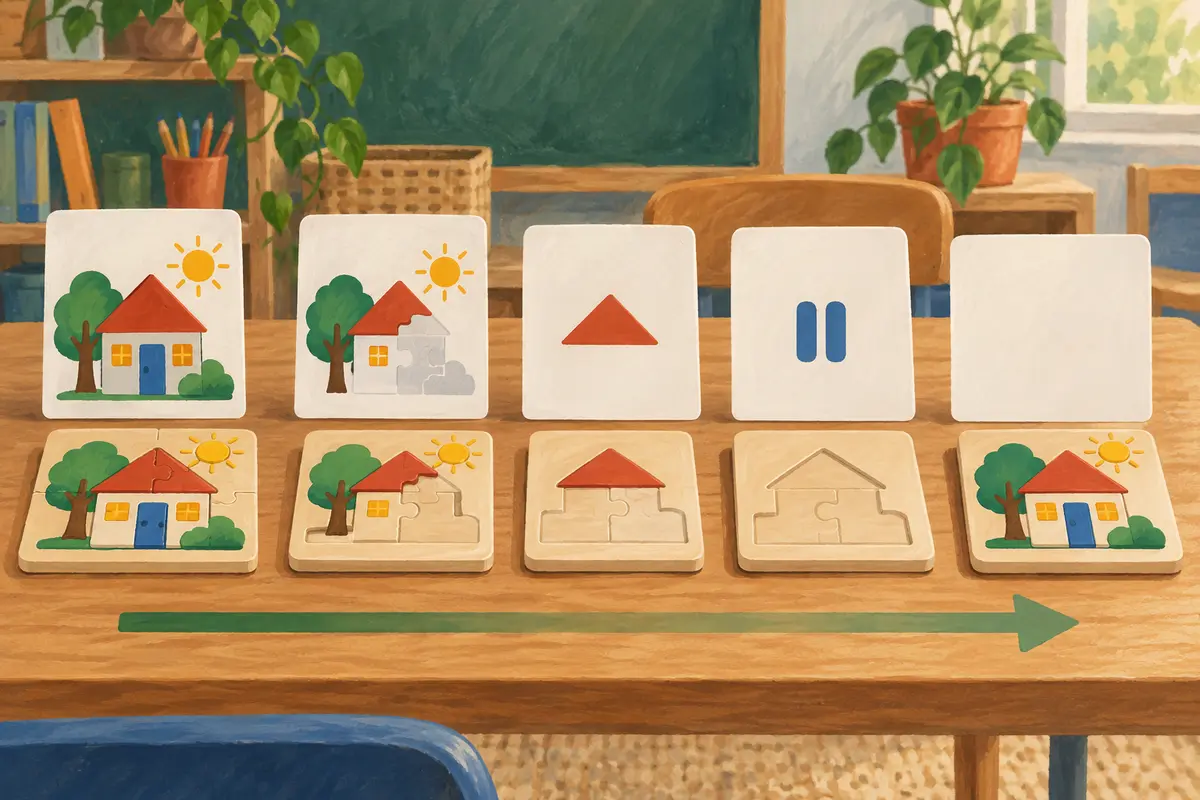
The generated cards are a conceptual prompt ladder, not a school programme or assessment instrument.
A tick for “completed” hides whether the adult delivered every step. Record the highest prompt needed, the part of the routine and any condition that changed the result. A learner who completes the same task with a gesture instead of a model has made meaningful progress even if the worksheet score is unchanged.
Review several occasions before reducing support again. A single independent attempt may not transfer to a noisy lesson, a different teacher or unfamiliar materials. Generalisation is part of the goal, but it should be tested carefully rather than assumed.
Keep the classroom teacher responsible for the learning
The classroom teacher sets the learning goal, explains the task and assesses the work. A support adult helps the learner access that teaching. Plan a discreet signal for when the shadow teacher should step in, and agree which feedback belongs to the teacher. This reduces the risk of a separate curriculum developing beside the class.
Our shadow teacher service is arranged only with school agreement and a clearly defined brief. Families based around Kerobokan can review Kerobokan tutoring arrangements, while in-school access and staffing remain subject to confirmation. See also the guide to working with a shadow teacher and the one-to-one handover checklist.
Frequently asked questions
Should an adult always use the least help first?
Usually use the least intrusive prompt likely to work, but safety, a new task or clear distress may require more direct support. The ladder is a planning tool, not a rigid rule.
What if independence drops when the classroom changes?
Return temporarily to a known prompt, identify what changed and fade again. Independence should generalise gradually across people, settings and materials.
Related
Message us on WhatsApp: +62 858 6969 6869 · info@privatetutoringbali.com · We reply within one working day.
Sources and further reading
Published by Private Tutoring Bali. Sources and corrections.