Primary maths reasoning
How to help a child explain their maths thinking
Ask the child to show the same idea with objects, a drawing, numbers and one clear sentence. The connections reveal more than a longer explanation.
Published

Begin with “show me” before “tell me why”
A child may understand a calculation but not yet have the language to explain it. Start with objects, fingers, counters or a quick drawing. Ask, “Can you show what the numbers mean?” This lowers the language demand while keeping the mathematical idea visible.
For 8 + 4, the child might make eight red counters and four blue counters, combine them and count twelve. The goal is not to stay with counters forever. It is to give the learner something concrete to describe and then connect to a representation and number sentence.
The opening AI-generated maths scene uses fictional Indonesian people to illustrate modelling; it does not portray our staff, a client or a school.
Connect four forms of the same idea
Move through four forms: objects, diagram, symbols and words. For 8 + 4 = 12, the child can group counters, draw a bar split into 8 and 4, write the equation, and say, “I combined eight and four, so the total is twelve.” Each form should represent the same relationship.
Do not rush to the sentence if the diagram and equation disagree. Ask which part of the picture represents each number. Correcting that connection is more useful than supplying polished mathematical vocabulary too early.
| Representation | Question to ask |
|---|---|
| Objects | What does each group represent? |
| Diagram | Where can I see the parts and the whole? |
| Number sentence | Which operation matches what happened? |
| Words | Can you explain the connection using because? |
Use prompts that leave the thinking with the child
Ask neutral prompts: “What did you do first?”, “How does your drawing match the equation?”, “What stayed the same?”, and “How could you check?” Avoid turning the explanation into a guessing game where the child tries to discover the adult’s exact sentence.
Wait after asking. A few quiet seconds give the child time to organise the steps. If they are stuck, point to one representation and ask about a specific part instead of explaining the whole solution for them.
Build one short reasoning sentence
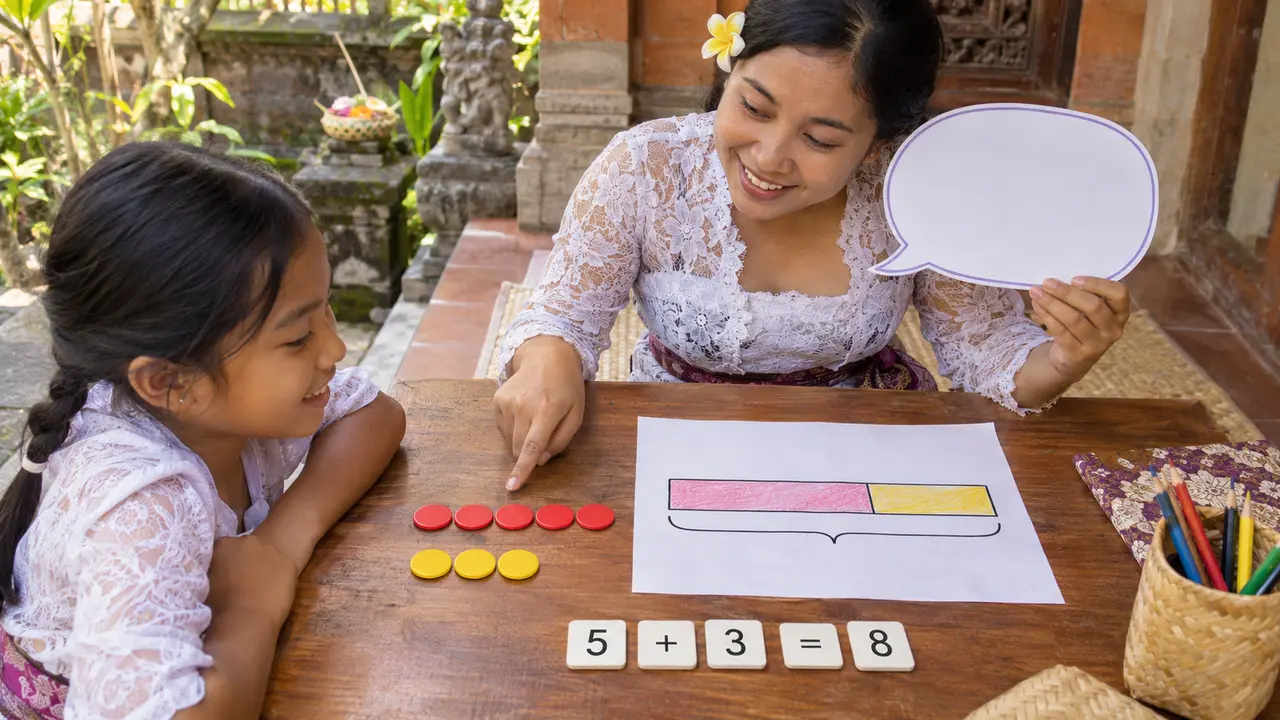
The counters-and-bar-model photograph is AI-generated with fictional people and does not document a real primary lesson.
A sentence frame can support language without replacing reasoning: “I know ___ because ___.” For example, “I know the whole is 12 because the two parts are 8 and 4.” Another useful frame is, “My answer is reasonable because…” followed by an estimate, inverse operation or comparison.
Remove the frame when the learner no longer needs it. The aim is flexible explanation, not a fixed script. Accept a clear spoken explanation before requiring a longer written one, especially when writing fluency would hide the maths.
Use mistakes as evidence about the model
When an answer is wrong, ask the child to show it. A model often reveals whether they misread the situation, chose the wrong operation, counted inaccurately or recorded the correct thinking incorrectly. Correct the point where the representations stop matching.
Then use a nearby example with different numbers. If the child can explain the new example, the idea may be becoming independent. Repeating the original immediately can measure memory of the correction instead.
Get support for reasoning and communication
If a primary learner can calculate but struggles to model, justify or check an answer, bring one current school example to a primary tutoring discussion. Share the curriculum and year level so the support matches the language and representations used at school.
Families arranging in-person lessons around Ubud can review the Ubud tutoring area page. For a place-value misconception, see why a child may write 402 as 42.
Frequently asked questions
What if a child gets the right answer but cannot explain it?
Ask them to show the idea with objects or a diagram first. Then connect that representation to the number sentence and one short explanation.
Should a child write a long paragraph for maths reasoning?
Usually no. A precise diagram, correct symbols and one or two clear sentences can show reasoning better than a long response. Follow the school task when it specifies a format.
Related
Message us on WhatsApp: +62 858 6969 6869 · info@privatetutoringbali.com · We reply within one working day.