Language-rich shared reading
How to expand a child’s sentences during shared reading
Listen first, repeat the child’s message with one useful addition and keep the story enjoyable instead of asking the child to copy every model.
Published

Follow the child’s attention in the book
Choose a picture book the child wants to revisit and sit where both of you can see it. Instead of testing every page, notice what the child points to or comments on. Their interest gives you a natural word or idea to build on.
Shared reading is still a story, not a drill. Mix comments with occasional questions and allow silence. NHS speech and language guidance recommends giving children time to respond rather than finishing their sentences for them.
The opening photograph is an AI-generated editorial illustration with fictional Indonesian people. It does not show a real learner, educator, assessment or speech-therapy session.
Use the match-plus-one pattern
Repeat the meaning the child expressed, then model one useful idea or grammatical step at the child’s current level. If the child says “dog”, an adult might respond, “Big dog.” The child hears a slightly richer model without being told their first attempt was wrong.
Choose the addition that fits the child’s current language and the picture. You might add an action, describing word, place or grammatical word. Avoid turning a two-word contribution into a long sentence the child cannot process.
| Child says | Adult models | Added idea |
|---|---|---|
| Baby sleep | The baby is sleeping | Natural grammar |
| Truck | Big truck | Describing word |
| Cat sleeping | The cat is sleeping | Natural grammar |
Pause without demanding repetition
After modelling, return to the story. The child does not need to repeat the sentence on command. Hearing the model in context gives them language they may use when ready.
A pause of several seconds can feel long to an adult but useful to a child who is formulating a response. Keep your expression attentive, and avoid stacking another question before the child has had time to answer.
Make one page into a short conversation
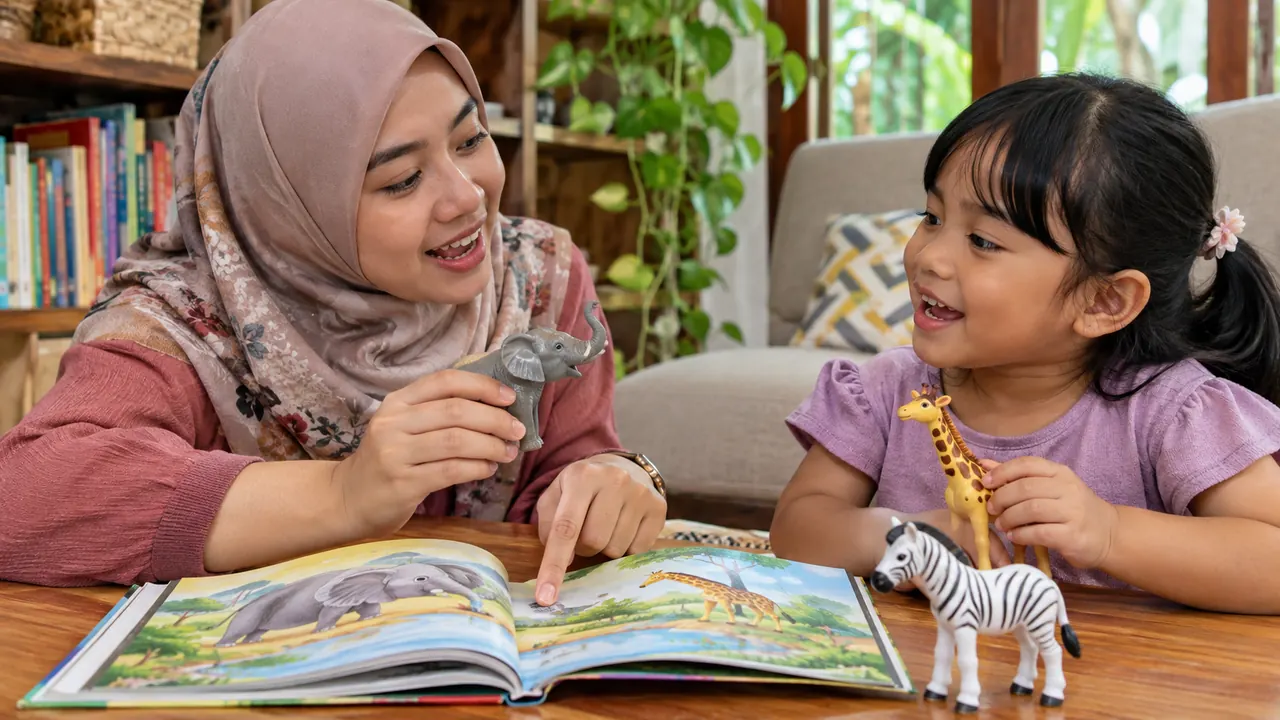
This second image is an AI-generated editorial illustration. It does not record a real child, speech target or tutoring session.
Use a toy, gesture or drawing to act out one event from the page. Model the same idea in two natural sentences, then let the child direct the play. Repetition across a meaningful activity is more useful than asking the same test question several times.
Stop while the child is still engaged. A short, positive reading routine repeated across the week gives more opportunities than one long session that becomes tiring.
Keep language support separate from diagnosis
Children develop language differently, and multilingual children may distribute vocabulary across languages. An article cannot determine whether a child has a delay. Parents concerned about speech, language or understanding should seek advice from a qualified speech and language professional.
If a therapist has given specific targets, use those rather than inventing a programme. A tutor can practise school vocabulary and shared reading in an educational context without presenting the work as therapy.
Connect the reading routine with school learning
Families can discuss educational vocabulary and reading support on the speech-delay support page. Share the child’s languages, current school work and any professional guidance when asking about a tutor.
Families in Denpasar can review local arrangements on the Denpasar tutoring page. For children learning English alongside another language, the guide on remembering and using new vocabulary offers a separate memory-focused routine.
Frequently asked questions
Should I ask my child to repeat the longer sentence?
Usually the adult can model the sentence and continue the interaction. Requiring repetition every time can turn shared reading into a test. Follow any specific guidance from the child’s speech and language professional.
Is sentence expansion a replacement for speech therapy?
No. It is a language-rich interaction strategy. Assessment, diagnosis and therapy belong with qualified speech and language professionals.
Related
Message us on WhatsApp: +62 858 6969 6869 · info@privatetutoringbali.com · We reply within one working day.